Introduction
Global AI spending hit $2.52 trillion in 2026 — a 44% year-over-year increase — and roughly 60% of workers now use sanctioned AI tools on the job. What started as experimental software has become core business infrastructure almost overnight.
That speed creates a real problem. With hundreds of tools claiming to be the best, choosing the wrong one wastes budget, fragments workflows, and erodes team trust.
The challenge isn't finding an AI tool — it's finding the right one. This guide identifies the AI tools that actually deliver ROI in 2026, so you can stop evaluating and start executing.
Key Takeaways
- AI tools now span specialized categories—the best ones solve specific jobs, not general hype
- Top picks: ChatGPT/Claude for general assistance, Cursor for coding, Midjourney for images, Sylus for governed data analysis
- Prioritize accuracy, security compliance, integration depth, and workflow fit over marketing claims
- Free tiers suit light use; enterprise teams need paid plans for reliability and compliance
- Highest ROI comes from tools that eliminate specific bottlenecks, not those that do everything passably
What to Look for in an AI Tool in 2026
AI capability is no longer the bottleneck. The real question is whether a tool performs reliably, handles your data securely, and fits how your team actually works.
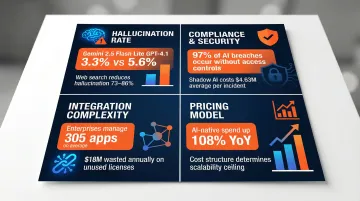
Four Critical Evaluation Criteria:
Hallucination rate matters more than headline performance. Gemini 2.5 Flash Lite sits at 3.3% vs. GPT-4.1's 5.6%. Web search access reduces hallucination rates by 73–86% across all models. Verify claims against independent benchmarks, not vendor marketing.
Verify compliance certifications before committing. 97% of AI-related breaches occur in organizations without proper access controls. Prioritize tools with SOC 2 Type II or HIPAA certification — both of which Sylus holds. Shadow AI incidents now average $4.63 million in damages, $670,000 above standard breach costs.
Integration gaps cost real money. The average enterprise manages 305 applications and wastes $18 million annually on unused licenses. New tools must connect directly with your existing stack — not add another silo to manage.
Match pricing model to your growth path. AI-native application spend jumped 108% year-over-year. Evaluate whether per-seat, per-task, or usage-based pricing aligns with how your team scales.
Common Mistakes to Avoid:
- Choosing tools based on viral demos rather than sustained performance
- Ignoring data handling policies, especially for proprietary business data
- Adopting overlapping tools that fragment team workflows and multiply training costs
Best AI Tools in 2026, by Category
These tools were evaluated across real-use performance, security posture, pricing transparency, and integration capability—not marketing claims.
AI Chatbots & General Assistants
Conversational AI for drafting, research, brainstorming, and summarization. ChatGPT and Claude dominate this tier with meaningfully different strengths.
ChatGPT (OpenAI)
ChatGPT reached 900 million weekly active users and 9 million business seats by early 2026, making it the most widely adopted AI assistant globally. Enterprise usage deepened significantly, with weekly messages growing 8x year-over-year.
Differentiators: Strongest ecosystem of third-party integrations via GPTs and API, multi-modal input (text, image, file), Deep Research automation, and voice mode. Ideal for document-grounded workflows requiring broad tool connectivity.
| Feature | Details |
|---|---|
| Best For | General productivity, research, multi-step reasoning, API-based integrations |
| Pricing | Free tier available; Plus at $20/month; Business at $25/user/month; Enterprise custom |
| Key Limitation | Can hallucinate on niche business data without proper grounding (GPT-5.2: ~78% hallucination rate when unsure) |
Claude (Anthropic)
Claude serves over 300,000 business customers with $14 billion in annualized revenue, establishing itself as the definitive choice for high-trust enterprise tasks. Deloitte deployed Claude to approximately 470,000 employees.
Differentiators: Excels at writing style consistency, following complex multi-step instructions, and processing very long documents. Claude 4.1 Opus achieves a 0% hallucination rate by refusing to guess rather than fabricating answers—making it structurally safer for legal, medical, and compliance workflows.
| Feature | Details |
|---|---|
| Best For | Writing, summarization, document review, task automation with detailed instructions |
| Pricing | Free tier; Pro at $20/month; Team at $20/seat/month (annual); Enterprise custom |
| Key Limitation | Smaller third-party integration ecosystem compared to ChatGPT |
AI Coding Assistants
AI coding tools have evolved from autocomplete to full-stack development support. In 2026, "vibe coding"—building apps via prompts without deep programming expertise—is mainstream, making these tools relevant beyond traditional developers.
Cursor
Cursor exceeded $2 billion in annualized revenue with over 1 million daily active users by early 2026, capturing the power-user and agentic coding market. Over half of the Fortune 500 use Cursor.
Differentiators: Native codebase awareness (understands your full project context), fast code generation and debugging, and strong model flexibility with support for multiple underlying LLMs. Dominates complex, multi-file agentic refactoring workflows.
| Feature | Details |
|---|---|
| Best For | Full-stack development, debugging, building apps through conversational prompts |
| Pricing | Free tier; Pro at $20/month; Teams at $40/user/month; Enterprise custom |
| Key Limitation | Requires some familiarity with coding environments; steeper learning curve for absolute beginners |
GitHub Copilot
Microsoft reported 4.7 million paid Copilot subscribers in January 2026, representing 75% year-over-year growth. Deployed at approximately 90% of Fortune 100 companies.
Differentiators: Best-in-class for teams already on GitHub. An Accenture study found Copilot drives an 8.69% increase in pull requests, a 15% increase in PR merge rate, and an 84% increase in successful builds. Offers code review suggestions, pull request summaries, and enterprise-level access controls.
| Feature | Details |
|---|---|
| Best For | Enterprise development teams, code reviews, GitHub-native workflows |
| Pricing | Individual at $10/month; Business at $19/user/month; Enterprise at $39/user/month |
| Key Limitation | Less effective outside the GitHub/VS Code ecosystem; limited standalone utility |
AI Image & Video Generation
Image and video generation has matured significantly—tools now produce physically accurate, high-resolution outputs with fewer artifacts, putting professional-quality output within reach for marketing teams, content creators, and product teams alike.
Midjourney
Midjourney generated $500 million in annual revenue with 21 million registered Discord users, holding a 26.8% share of the global AI image generator market—all without external venture funding.
Differentiators: Best-in-class visual aesthetics, strong style consistency, and a large prompt-sharing community that helps users generate better outputs faster. Dominates static image generation for marketing and creative direction.
| Feature | Details |
|---|---|
| Best For | Marketing visuals, creative direction, brand imagery, concept art |
| Pricing | Basic at $10/month; Standard at $30/month; Pro at $60/month; Mega at $120/month |
| Key Limitation | No free tier; operates via Discord, creating a steeper onboarding experience |

Sora 2 (OpenAI)
Released September 30, 2025, Sora 2 introduces physically accurate dynamics, synchronized audio, and cameo insertion (adding yourself into generated videos).
Differentiators: Physics-aware video generation—a basketball rebounds off a backboard rather than teleporting. High controllability across multiple shots. Synchronized dialogue and sound effects. Tighter integration with the broader ChatGPT ecosystem.
| Feature | Details |
|---|---|
| Best For | Short-form video creation, product demos, social media content |
| Pricing | Free via dedicated iOS app; experimental Sora 2 Pro available to ChatGPT Pro subscribers |
| Key Limitation | Limited video length; best results require careful prompt engineering; ongoing moderation challenges |
AI Data Analysis & Business Intelligence
Most AI tools analyze surface-level text, but business decisions require deep, accurate, governed analysis of proprietary data. Poor data quality costs organizations an average of $12.9 million annually, and models inherit and amplify underlying data flaws.
Sylus
Sylus is an enterprise-grade AI data analyst that connects directly to your data sources and allows teams to query data in plain English. Built on governed context using dbt models and documentation to ground all analysis in verified business logic.
Differentiators: Unlike generic AI tools that hallucinate on business data, Sylus validates assumptions before returning results. Key capabilities include:
- Grounds all analysis in dbt models and documentation—no fabricated metrics
- Generates shareable dashboards queryable directly from Slack
- Unlimited seats with usage-based pricing
- SOC 2 Type II and HIPAA compliant
- Self-hosted deployment available for full data sovereignty
- Neither Sylus nor its model partners train on customer data
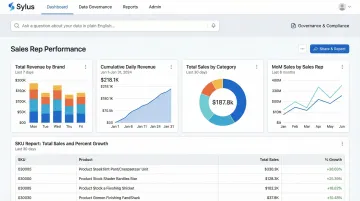
Trusted by fast-growing startups to Fortune 1000 enterprises, including OpenAI.
| Feature | Details |
|---|---|
| Best For | Data teams and business users who need accurate, governed AI analysis of internal business data |
| Pricing | Usage-based pricing with unlimited seats; contact Sylus for enterprise and self-hosted plans |
| Key Differentiator | Governed context grounded in dbt models; SOC 2 Type II + HIPAA compliant; no model training on customer data; self-hosted option available |
AI Workflow Automation
Automation tools sit at the intersection of AI and operations. In 2026, the best platforms don't just connect apps—they deploy AI agents that handle multi-step decisions autonomously, reducing manual handoffs across teams.
Zapier
Zapier supports over 8,500 app integrations and serves over 3 million users, including more than 100,000 paying customers. The industry standard for rapid, no-code automation.
Differentiators: Fastest path to automation for non-technical users. Strong AI agent and chatbot builder. Massive app library cuts costs compared to per-task models—approximately $10-15/month for 10,000 runs when self-hosted.
| Feature | Details |
|---|---|
| Best For | Technical teams building custom AI agents and workflows with strict data control requirements |
| Pricing | Free to self-host (open-source); Cloud Starter at €20/month (2,500 executions); Pro at €50/month; Business at €667/month |
| Key Limitation | Steeper learning curve; requires technical resources to manage self-hosted infrastructure |
How We Chose These AI Tools
These tools were assessed across five dimensions:
- Real-world output quality vs. marketing claims - Independent benchmarks and user feedback, not vendor demos
- Security and compliance posture - SOC 2, HIPAA, data handling policies, and breach history
- Pricing model fairness and scalability - Whether costs align with value delivered as usage grows
- Integration depth with existing business tools - Seamless connectivity vs. creating new silos
- Breadth of credible user feedback - Enterprise adoption rates, customer testimonials, and independent testing
Even with a clear evaluation framework, buyers routinely trip over the same pitfalls. Here's what to watch for:
Common Selection Mistakes to Avoid:
- Defaulting to the most popular tool without assessing fit for your specific use case
- Ignoring data privacy policies, especially for tools handling proprietary business data
- Underestimating total cost of adoption—training, integration, and maintenance add up quickly
The "best" tool is always context-dependent. A general chatbot is the wrong choice for governed data analysis, and an enterprise data platform is overkill for individual content creators. Match the tool to the job — not the other way around.
Conclusion
In 2026, most teams have adopted AI tools. The gap now is between teams using tools that actually fit their data, security requirements, and scale—and those burning budget on generic solutions that don't deliver reliable answers.
For teams that need to analyze business data accurately and securely, Sylus offers AI-powered analytics grounded in your own data—with unlimited seats, SOC 2 Type II and HIPAA compliance, and no model training on your data. Schedule a demo to explore how Sylus can give your data team faster, more reliable answers.
Frequently Asked Questions
Frequently Asked Questions
Which is the best AI tool currently?
ChatGPT, Claude, and Google Gemini lead the general-purpose category, each with distinct strengths. "Best" depends on use case—for example, Sylus is the strongest choice for AI-powered business data analysis with governed context.
What are the 4 types of AI software?
The four core types are reactive machines (rule-based, no memory), limited memory AI (learns from data—such as current LLMs), narrow AI (task-specific tools, and the only type that exists today), and general AI (still theoretical). Most 2026 tools fall into the narrow or limited memory category.
What is the best free AI tool to use in 2026?
ChatGPT (10 messages with GPT-5.3 per 5-hour window), Claude (15–40 messages per window), and Google Gemini all offer capable free tiers. They're fine for evaluation, but aggressive limits make paid plans necessary for any serious business use.
Which AI tool is best for data analysis?
Tools like Sylus are purpose-built for business data analysis with governed context grounded in dbt models, ensuring accuracy and compliance. General chatbots like ChatGPT can support surface-level analysis but lack the grounding needed for accurate, enterprise-grade insights.
How do I choose the right AI tool for my team?
Start with four criteria:
- Use case fit: Does it actually solve your specific problem?
- Compliance: Does it meet your data privacy requirements (SOC 2, HIPAA)?
- Integration: Does it connect to your existing stack without creating new silos?
- Pricing: Does cost scale fairly with team size or usage?
Are AI tools safe for business use?
Safety depends on the tool's data handling policies. Look for SOC 2 or HIPAA certification, a clear commitment to not training models on your data, and self-hosted or private deployment options for sensitive environments.