Introduction
Most companies aren't facing a data shortage—they're drowning in it. Yet business users still wait hours or days for a simple report. Marketing needs last week's campaign ROI. Sales wants this quarter's pipeline breakdown. Finance is reconciling three different revenue numbers from three different dashboards. The bottleneck isn't the data itself; it's the structural failure of traditional BI to deliver access at the speed of business.
Many BI platforms have responded by adding AI features—a chatbot here, an auto-insight widget there. But bolting AI onto legacy reporting architecture is not the same as building with AI as the foundation. The distinction isn't semantic; it determines whether your team gets answers in seconds or stays stuck in analyst queues.
The gap between the two approaches is measurable—in analyst hours lost, in metric conflicts left unresolved, and in decisions made on stale data.
TL;DR
- AI-first BI is built around AI as the core engine, not retrofitted: this shapes speed, governance, and access
- Business users query data in plain English and receive instant, validated answers without SQL knowledge or analyst dependency
- Governed semantic layers (like dbt models) ground AI analysis in verified metric definitions, eliminating the "which number is right?" problem
- Proactive intelligence replaces reactive dashboards—automated anomaly detection and AI summaries surface insights before anyone asks
- Traditional BI costs compound: analyst bottlenecks widen, metric conflicts erode trust, and insights arrive too late
What Is an AI-First BI Tool?
An AI-first BI tool is a business intelligence platform where AI serves as the primary interface and analytical engine—not a plug-in layered over legacy dashboards. Traditional BI generates charts that humans interpret; AI-first BI interprets the data itself and surfaces answers and recommendations directly.
That architectural difference has real consequences. It determines who can access insights (technical users only, or entire business teams), how fast those insights arrive, and whether the answers rest on governed metrics or ad-hoc approximations. Most BI tools struggle on at least two of those three counts.
Gartner defines an AI-first strategy as considering AI as the primary option for every decision and investment. In BI, this means the platform is built from the ground up without legacy dashboard baggage, treating queries as ongoing dialogue rather than static reports pulled from predefined views.
The result is a fundamentally different relationship between business teams and their data — one where answers come in seconds, not service tickets.
Key Advantages of AI-First BI Tools
The advantages below are grounded in operational impact: how work actually gets done, how fast decisions get made, and what risks get reduced.
Natural Language Querying Removes the Analyst Bottleneck
The advantage: Any user—regardless of SQL knowledge—types a plain-English question and receives an instant, accurate answer. The AI translates intent into query and result.
How this changes workflow:
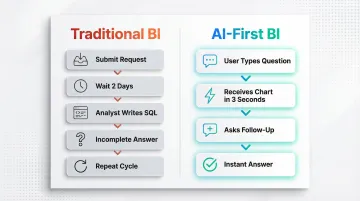
Instead of this traditional process:
- Business user submits data request to analyst
- Request sits in queue for 2 days
- Analyst writes SQL query, generates static chart
- Chart may not answer original question
- User submits follow-up request, cycle repeats
AI-first BI delivers this:
- User types "Show me top customers by revenue this quarter"
- Receives bar chart with analysis in 3 seconds
- Asks immediate follow-up: "Now break that down by region"
- Gets answer instantly
Why this matters:
Data scientists spend 50-80% of their time on mundane data preparation and repetitive reporting rather than strategic analysis. Meanwhile, only 20% of enterprise decision-makers who could use analytical applications actually do so—the other 80% still rely on that 20% for data sourcing, discovery, and insights.
Every delayed insight is a delayed decision. When Medtronic implemented modern self-service analytics, their data team went from answering 100% of procurement users' questions to handling just 20%, with business users taking on 80% of their own analysis.
KPIs impacted:
- Time-to-insight (days → seconds)
- Analyst utilization rate (repetitive queries → strategic work)
- Data request backlog depth
- Decision cycle time
When this advantage matters most:
This amplifies at scale—when data teams are small relative to business users needing answers, or during fast-moving situations (campaign launches, sales cycles, operational crises) where waiting hours isn't viable.
Governed AI Analysis Prevents Costly Errors
The advantage: AI-first tools grounded in a governed semantic layer—such as dbt models and documentation—ensure every AI-generated answer anchors to verified metric definitions, not approximated from raw data.
How this works in practice:
When a user asks "What is our monthly recurring revenue?", an AI-first tool built on governed context pulls from the same MRR definition used by every team. This eliminates the scenario where Finance reports $450K MRR while Sales reports $520K because they're calculating from different sources with different logic.
Platforms like Sylus ground all analysis in dbt models and documentation, ensuring AI answers are validated against your team's source of truth rather than generated ad hoc.
Why this matters:
Poor data quality costs organizations $12.9 million annually through operational inefficiencies and flawed decisions. Organizations with poor data quality see 60% higher project failure rates than those with strong quality programs.
The most cited failure mode of AI in analytics is hallucination—answers that sound confident but are based on inconsistent or wrong data. In financial, operational, or compliance contexts, ungoverned AI outputs cause real downstream harm. A semantic layer eliminates these debates by driving consistency of terminology and calculation, ensuring organizations work off the same metric everywhere.
KPIs impacted:
- Data trust score across teams
- Metric consistency (Finance vs. Sales vs. Operations)
- Error rate in reports and dashboards
- Time spent reconciling conflicting numbers
When this advantage matters most:
This is critical for organizations with multiple data sources, cross-functional reporting needs, regulated industries (healthcare, finance), or teams that have experienced the "which number is right?" problem.
Proactive Intelligence Replaces Reactive Reporting
The advantage: AI-first BI tools don't wait to be asked—they surface anomalies, generate automated summaries, and alert teams to significant changes before anyone runs a query.
The real-world shift:
Traditional BI: Team reviews weekly dashboard on Monday, notices a metric dropped 15% on Thursday. By the time they investigate, the issue has compounded for four days.
AI-first BI: Platform detects the 15% drop Thursday morning, flags the anomaly in real-time, explains what changed, and delivers summary directly to Slack. Team investigates immediately.
Why this matters:
71% of organizations report decision-making demands are becoming more rapid and complex. Without real-time data, decisions are based on yesterday's insights. Companies in the top quartile of "real-time-ness" achieve 50% higher revenue growth and net margins compared to bottom-quartile companies.
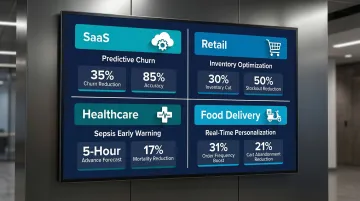
Cross-industry impact:
| Industry | Use Case | Business Impact |
|---|---|---|
| SaaS | Predictive churn analytics | 35% churn reduction; 85% accuracy in early warnings |
| Retail | Inventory optimization | 30% excess inventory cut; 50% stockout reduction |
| Healthcare | Sepsis early warning | Forecast sepsis 5 hours in advance; 17% mortality reduction |
| Food delivery | Real-time personalization | 31% order frequency boost; 21% cart abandonment reduction |
KPIs impacted:
- Mean time to detect anomalies
- Alert-to-action speed
- Scheduled reporting meetings replaced by automated summaries
- Operational response time
When this advantage matters most:
Highest impact for teams managing high-frequency operations (e-commerce, SaaS metrics, logistics, clinical workflows) where conditions change significantly within hours and scheduled reporting creates dangerous blind spots.
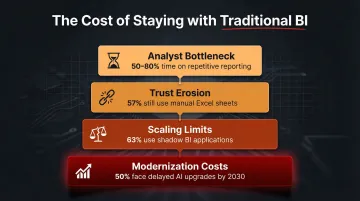
What Happens When You Stick with Traditional BI
Analyst bottleneck. The cost of legacy BI compounds over time. As data volume grows, analyst queues grow longer, leaving the people who most need answers waiting the longest. Analysts spend 50-80% of their time on repetitive reporting instead of strategic analysis, creating a structural bottleneck that widens as demand increases.
Trust erosion. When different teams pull numbers from different dashboards and get different answers, confidence in data collapses—and decisions revert to gut feeling. In 2024, 57% of organizations relied on manual Excel sheets to manage customer intelligence, leading to fragmented data and measurement crises. This isn't a people problem; it's a systems problem that AI-first governance solves structurally.
Scaling limits. That structural problem becomes more visible under load. Traditional BI with manual SQL-based workflows doesn't scale gracefully. Approximately 63% of business decision-makers use equal or more shadow BI applications versus enterprise platforms—a clear signal that centralized BI isn't meeting needs. As data sources multiply and request volume climbs, the gap between what teams need and what analysts can deliver grows wider. AI-first BI scales access without scaling headcount.
Modernization costs. These operational limits carry a direct financial cost. AI tools can accelerate legacy modernization by 40-50%, compressing timelines by 75%—reducing an 18-month project to 4-5 months. Organizations that defer this transition face increasing technical debt; by 2030, 50% of enterprises will face delayed AI upgrades and rising maintenance costs due to unmanaged GenAI technical debt.
How to Get the Most from an AI-First BI Platform
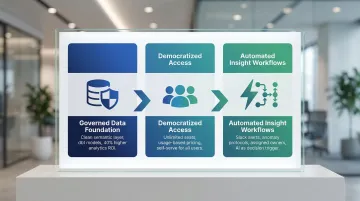
Start with Governed, High-Quality Data
AI output is only as reliable as the data feeding it. Investing in a clean semantic layer—dbt models with proper documentation—before deployment delivers increasing returns over time. Organizations with mature governance show 40% higher analytics ROI through improved data quality and trust. Companies that resolve governance challenges first deploy AI 3x faster with 60% higher success rates.
Open Access to Everyone Who Needs It
Value scales with every additional business user who can self-serve. Traditional per-seat pricing creates artificial barriers to adoption — limiting BI to analysts rather than the decision-makers who act on the data. By 2025, 85% of SaaS leaders had adopted usage-based models, and 70% of businesses will prefer usage-based pricing by 2026. Platforms with unlimited seats remove cost as a reason to keep data locked away.
Build Workflows Around Automated Insights
Shifting from BI as a reporting function to BI as a continuous intelligence system requires more than technology — it requires teams to act on AI-generated alerts and summaries, not just receive them. That means putting lightweight processes in place:
- Route Slack alerts to the right owners so nothing sits unread
- Establish response protocols for anomaly notifications before issues escalate
- Assign clear owners for recurring AI-generated summaries and weekly digests
- Treat AI insights as triggers for decisions, not just information to log
Conclusion
AI-first BI represents a structural shift in how organizations access, trust, and act on data — not just a layer of automation on top of existing workflows. The advantages compound because faster decisions, fewer errors, and broader access reinforce each other. Each day an analyst doesn't spend generating routine reports is a day they can spend on predictive modeling. Each metric conflict prevented is trust preserved. Each anomaly caught early is revenue protected.
The gap between AI-first and traditional BI widens as data volume and team complexity grow. Organizations adopting AI-first tools now build a compounding advantage: analysts shift from report generation to strategy, decisions happen faster and with higher confidence, and data governance prevents the trust erosion that consistently undermines legacy BI implementations.
The organizations winning on data are the ones where every person who needs an answer can get it immediately — without waiting in a queue, and without doubting whether the number is right.
Frequently Asked Questions
What is the difference between an AI-first BI tool and a traditional BI tool with AI features?
AI-first tools are built around AI as the primary interface and analytical engine from the ground up. Traditional BI tools with AI features layer natural language processing or automation on top of legacy reporting systems. That architectural difference determines reliability, governance depth, and whether self-service scales past the initial 20% of technical users.
Do users need SQL or data science skills to use AI-first BI tools?
No. AI-first BI tools are specifically designed to eliminate that requirement. Business users query data in plain English—"Show me top customers by revenue this quarter"—and receive answers, charts, or dashboards without writing a single line of code or SQL.
How do AI-first BI tools maintain accuracy and avoid hallucinations?
The strongest AI-first platforms ground all analysis in a governed semantic layer—dbt models and documentation—so AI answers are validated against verified metric definitions, not inferred from raw data. This prevents the metric drift and conflicting numbers that erode trust in traditional BI.
Are AI-first BI tools secure enough for enterprise or regulated industries?
Leading AI-first BI platforms meet enterprise security standards: SOC 2 Type II and HIPAA compliance, self-hosted deployment for air-gapped environments, and contractual policies that prevent customer data from training AI models.
How long does it take to see results after adopting an AI-first BI tool?
Teams typically see immediate time-to-insight gains once connected to a data source—users can query in plain English right away. Deeper ROI from automated dashboards, anomaly detection, and reduced analyst dependency builds as adoption spreads across the organization.
Can AI-first BI tools integrate with existing data infrastructure like dbt or cloud data warehouses?
Yes. Modern AI-first BI tools connect directly to cloud warehouses and leverage existing dbt models and documentation as the governed foundation for AI analysis. This means there's no need to rebuild your data layer from scratch—the platform works with the infrastructure you've already built.