Introduction
The average enterprise now manages 897 applications, with 71% remaining unintegrated—creating operational blind spots that delay critical business decisions. As data sources multiply from SaaS tools and cloud databases to streaming APIs, fragmented data has become the #1 bottleneck for analytics-ready teams in 2026.
That fragmentation has a price. Choosing the wrong data integration tool leads to pipeline failures, schema drift, spiraling engineering costs, and delayed insights. Poor data quality costs organizations an average of $12.9 million annually, while 68% of enterprise data sits unused in silos.
This guide covers the top data integration tools for 2026, the criteria that separate strong platforms from costly mistakes, and a comparison framework to match the right tool to your specific use case: cloud-native ELT, enterprise governance, API connectivity, or open-source flexibility.
Key Takeaways
- Data integration tools extract, transform, and load data from multiple sources into centralized destinations like data warehouses or data lakes
- The best tool depends on your use case—Fivetran for cloud-native ELT, Informatica for governance, Boomi for hybrid deployment, MuleSoft for API connectivity, Airbyte for open-source flexibility
- Evaluate tools on connector coverage, deployment model, compliance certifications, and pricing transparency
- After centralizing your data, Sylus lets any team member query it in plain English and generate shareable dashboards instantly—no SQL needed
What Is Data Integration and Why Does It Matter in 2026?
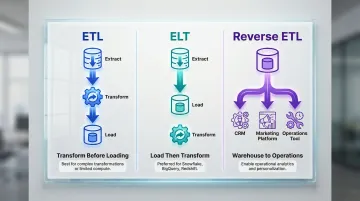
Data integration is the process of extracting data from multiple siloed sources, transforming it into a consistent format, and loading it into a target system such as a data warehouse, data lake, or operational application. The three core paradigms are:
- ETL (Extract, Transform, Load): Transforms data before loading, ideal for complex transformations or limited warehouse compute
- ELT (Extract, Load, Transform): Loads raw data first and transforms inside the warehouse, preferred for modern cloud warehouses like Snowflake, BigQuery, or Redshift with elastic compute
- Reverse ETL: Syncs data from a centralized warehouse back into operational systems like CRMs or marketing platforms
The 2026 Context
According to IDC, 68% of enterprise data remains underutilized — a "silent productivity tax" that slows decision-making across teams. This fragmentation costs organizations an average of $12.9 million annually in poor data quality alone.
The data integration software market reached $5.9 billion in 2024 with 9.8% growth, while the broader iPaaS market is projected to hit $21.38 billion by 2035. The tools reviewed here were evaluated on four criteria:
- Market presence — adoption and ecosystem maturity
- Connector coverage — breadth of supported data sources and destinations
- Compliance posture — support for SOC 2, HIPAA, and enterprise security requirements
- Real-world fit — usability across both startup and enterprise environments
Top Data Integration Tools for 2026
Selection was based on connector library size, deployment flexibility (cloud, hybrid, self-hosted), compliance certifications (SOC 2, HIPAA, GDPR), pricing transparency, and suitability across different organizational maturity levels—from cloud-native startups to F1000 enterprises replacing legacy ETL infrastructure.
Fivetran
Fivetran is a fully managed, cloud-native ELT platform known for automating data ingestion with 700+ pre-built connectors and near-zero maintenance overhead. It pioneered automated schema drift handling, making it a go-to for analytics teams that prioritize reliability over pipeline customization.
Fivetran handles schema changes, API updates, and connector maintenance automatically—freeing engineering teams from pipeline upkeep. It integrates natively with dbt Core for in-warehouse transformations, making it a natural fit for modern data stacks on Snowflake, BigQuery, or Redshift.
| Feature | Details |
|---|---|
| Key Features | 700+ pre-built connectors, automated schema drift handling, native dbt integration, sub-5-minute sync frequency, Change Data Capture (CDC) support |
| Best For | Data teams that want SaaS and database data in their cloud warehouse without building or maintaining pipelines |
| Pricing | Consumption-based (Monthly Active Rows); free and paid plans available starting at $5 base charge for standard connections |
| Compliance | SOC 2 Type II, ISO 27001, PCI DSS Level 1, HIPAA, GDPR |
User Feedback: G2 users rate Fivetran 4.3/5 stars, praising ease of use and wide connector range but noting expensive MAR pricing and unexpected full reloads.
Informatica
Informatica is the enterprise standard for organizations that need data integration alongside master data management (MDM), data quality, and governance. Its Intelligent Data Management Cloud (IDMC) covers the full data lifecycle and is trusted by large organizations with complex, multi-system environments.
The CLAIRE AI engine automates data discovery, mapping, and cleansing tasks across 50,000+ source-target combinations. Its compliance portfolio is among the most comprehensive available, which explains its appeal to regulated industries with strict governance requirements. Notably, Informatica has been named a Leader in the 2025 Gartner Magic Quadrant for Data Integration Tools for the 20th consecutive year.
| Feature | Details |
|---|---|
| Key Features | AI-powered CLAIRE engine, MDM capabilities, data quality and lineage tools, hybrid/multi-cloud deployment, 50,000+ source-target combinations |
| Best For | Large enterprises requiring a single platform for data integration, governance, data quality, and MDM |
| Pricing | Consumption-based via Informatica Processing Units (IPUs); custom quote required |
| Compliance | SOC 1 Type 2, SOC 2, SOC 3, ISO 27001, HIPAA, PCI DSS, GDPR |
User Feedback: Gartner Peer Insights users rate Informatica 4.4/5 stars, highlighting breadth of capabilities but noting complex and expensive consumption-based pricing.
Boomi
Boomi is a cloud-native iPaaS that unifies application integration, data integration, EDI, API management, and workflow automation in a single platform. It is especially well-regarded for hybrid environments connecting on-premise systems with cloud applications.
Boomi's 1,000+ pre-built connectors, low-code drag-and-drop interface, and scalable architecture make it accessible for technical and non-technical users alike. It is one of the few platforms that handles EDI alongside modern API and data integration—a practical advantage for supply chain and logistics organizations.
| Feature | Details |
|---|---|
| Key Features | 1,000+ connectors, EDI and API management, real-time and batch processing, hybrid deployment, low-code visual builder |
| Best For | Enterprises connecting cloud and on-prem systems, particularly those with EDI requirements or hybrid IT ecosystems |
| Pricing | Pay-As-You-Go starting at $99/month plus usage; custom enterprise pricing for large deployments |
| Compliance | SOC 1, SOC 2, ISO 27001, PCI DSS, HIPAA, GDPR (EU-U.S. Data Privacy Framework) |
User Feedback: G2 users rate Boomi 4.4/5 stars, appreciating ease of use and low-code functionality but noting high licensing costs at scale.
MuleSoft
MuleSoft's Anypoint Platform is an enterprise integration platform centered on API-led connectivity. It is a widely adopted choice for large organizations building application networks across diverse, distributed systems and has deep strength in both cloud and on-premise integration.
MuleSoft covers the full API lifecycle—design, build, publish, management, and security—alongside data integration, making it well-suited for organizations modernizing legacy systems while keeping traditional B2B workflows intact. That breadth comes with trade-offs: the platform requires skilled developers and carries a higher total cost of ownership than most alternatives. MuleSoft was named a Leader in the 2025 Gartner Magic Quadrant for API Management for the 10th consecutive year.
| Feature | Details |
|---|---|
| Key Features | Unified API and integration platform, pre-built connectors, hybrid deployment (cloud and on-prem), API lifecycle management, ESB capabilities |
| Best For | Large enterprises with complex API management needs and developer teams building distributed application networks |
| Pricing | Capacity-based subscription (Mule Flows and Messages); custom quote required |
| Compliance | ISO 27001, SOC 1, SOC 2, PCI DSS, HIPAA, GDPR |
User Feedback: G2 users rate MuleSoft 4.5/5 stars, praising the unified platform and extensive features but citing high cost and steep learning curve.
Airbyte
Airbyte is the leading open-source ELT platform with 600+ connectors. It can be self-hosted for free or deployed via Airbyte Cloud, making it the most cost-effective option for teams with DevOps resources who want full control over their connectors and pipeline code.
Unlike managed platforms, Airbyte lets teams inspect and modify connector source code, build custom connectors via its Connector Development Kit (CDK), and avoid vendor lock-in entirely. It integrates with dbt for transformations. The trade-off: self-hosting requires infrastructure management and ongoing engineering maintenance.
| Feature | Details |
|---|---|
| Key Features | 600+ open-source connectors, Connector Development Kit (CDK), self-hosted or cloud deployment, CDC support, dbt integration |
| Best For | Engineering teams that want open-source flexibility, cost control, and the ability to build custom connectors for unsupported sources |
| Pricing | Free for self-hosted deployments (infrastructure costs only); Airbyte Cloud starts at $10/month with credit-based or capacity-based pricing |
| Compliance | Documentation not publicly detailed; suitable for teams managing their own compliance posture |
User Feedback: G2 users rate Airbyte 4.4/5 stars, appreciating flexibility and the open-source option but noting that some connectors can be buggy and debugging takes time.
SnapLogic
SnapLogic is a low-code integration platform built around modular "Snaps"—pre-built connectors for applications, APIs, and data sources—that users drag and drop to build pipelines. Its AI assistant (Iris) provides real-time pipeline building suggestions, and it supports ETL, ELT, and real-time data processing at enterprise scale.
SnapLogic works well for organizations that want application integration and data integration in one self-service platform. Its 1,000+ Snaps library and AI-assisted development make pipelines accessible to business users without sacrificing the centralized governance and security controls IT teams require. SnapLogic was named a Visionary in the 2025 Gartner Magic Quadrant for Data Integration Tools.
| Feature | Details |
|---|---|
| Key Features | 1,000+ Snaps (pre-built connectors), AI assistant (Iris) and SnapGPT, ETL/ELT/real-time support, unified app and data integration, cloud-native scalability |
| Best For | Enterprises seeking a scalable, visual integration platform with AI-assisted pipeline development across both application and data integration use cases |
| Pricing | Package-based with unlimited data movement; custom quote required |
| Compliance | Documentation not publicly detailed; contact vendor for compliance certifications |
User Feedback: G2 users rate SnapLogic 4.4/5 stars, highlighting ease of use and AI recommendations but noting performance issues with very large data volumes.
How We Chose the Best Data Integration Tools
Evaluation covered five core dimensions:
- Connector library size and reliability: Both pre-built and custom connector support, with emphasis on maintenance, schema drift handling, and API update management
- Deployment flexibility: Cloud-only, hybrid, or self-hosted options to match organizational infrastructure requirements
- Compliance certifications: SOC 2 Type II, HIPAA, GDPR, and other standards relevant to enterprise buyers
- Pricing model transparency: Total cost of ownership including infrastructure, maintenance, and support—not just licensing fees
- Verified user feedback: G2, Gartner Peer Insights, and public case studies
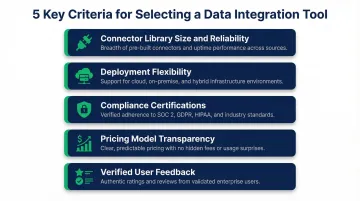
These criteria exist because the most common selection mistake is choosing a tool based on brand name without validating connector coverage for your specific sources and destinations. Consumption-based pricing models (charging by rows or compute units) offer low upfront costs but frequently cause budget overruns during data spikes.
Final selection prioritized tools that address distinct buyer profiles: cloud-native analytics teams (Fivetran), enterprise governance-heavy organizations (Informatica), API-first architectures (MuleSoft), open-source/DevOps-oriented teams (Airbyte), and low-code business users (SnapLogic, Boomi). Evaluate each option against your actual stack, data volume, and internal technical capacity before committing.
Conclusion
There is no single "best" data integration tool—the right choice depends on your data stack architecture, team's technical depth, compliance requirements, and whether you're building greenfield pipelines or modernizing legacy ETL infrastructure.
Run a short proof-of-concept against your highest-priority data sources before committing to a platform. Evaluate on connector reliability, setup time, error handling, and support quality—not just feature lists or pricing tiers.
Once your data is integrated and centralized, the next challenge is making it accessible for analysis. Sylus is built for exactly that step. It lets your data team and business users:
- Query centralized data in plain English—no SQL required
- Generate and customize dashboards automatically
- Schedule AI-generated summaries to Slack or email
- Ground every analysis in your dbt models and documentation for governed, accurate results
If you're building out your data stack in 2026, pairing a solid integration layer with an AI analytics layer like Sylus means your pipelines actually drive decisions—not just storage costs.
Frequently Asked Questions
What is the best data integration platform?
There is no single best platform—the right choice depends on use case. Fivetran leads for cloud-native ELT, Informatica for enterprise governance, Boomi for hybrid/iPaaS, MuleSoft for API-led connectivity, and Airbyte for open-source flexibility. Match the tool to your specific stack and team profile.
What tools are best for replacing legacy ETL systems in large organizations?
For legacy ETL replacement at scale, Informatica, Boomi, and MuleSoft are the strongest choices—MuleSoft especially when API modernization is part of the migration. Plan for a phased migration rather than a full cutover to reduce risk.
What is the process of merging data from different sources called?
Combining data from multiple sources is called data integration. It encompasses ETL (Extract, Transform, Load), ELT (Extract, Load, Transform), and data federation—all of which move and unify data into a central destination for analysis.
What is the difference between ETL and ELT?
ETL transforms data before loading it (better for complex transformations or limited warehouse compute), while ELT loads raw data first and transforms inside the warehouse (preferred for modern cloud warehouses like Snowflake, BigQuery, or Redshift with elastic compute). If you're on a modern cloud warehouse, ELT is typically the faster and more cost-effective path.
What is the difference between iPaaS and a data integration tool?
iPaaS connects applications and automates workflows across your tech stack (bidirectional sync, API management), while data integration tools focus on moving data to analytical destinations. Boomi and MuleSoft cover both use cases; Fivetran and Airbyte are purpose-built for data integration only.
How much do data integration tools typically cost?
Pricing spans from free (open-source tools like Airbyte) to $100+/month for SMB tools, $1,000–$2,000+/month for mid-market platforms, and $50,000–$200,000+/year for enterprise suites like Informatica. Always factor in infrastructure, maintenance, and support costs alongside licensing.