Introduction
Modern businesses run on data scattered across dozens of disconnected tools—CRMs, ERPs, databases, spreadsheets, and SaaS applications. This fragmentation has a measurable cost: according to Forrester Research, data teams spend 70% of their time preparing external data rather than analyzing it, while Salesforce research shows employees waste 12 hours weekly searching for information across disconnected systems. Meanwhile, poor data quality costs organizations an average of $12.9 million annually.
AI tools are closing this gap by automating data connections and letting any team member query data in plain English—no SQL required. The best platforms go beyond dashboards: they make data governable, shareable, and useful for business users, not just analysts. This guide evaluates the top tools for centralizing business data and what sets them apart.
Key Takeaways
- The best AI data tools connect live sources, automate analysis, and surface insights on demand—not just static dashboards
- Strong solutions pair data integration (getting data in one place) with conversational AI querying
- Key selection factors: source compatibility, SOC 2/HIPAA compliance, governance controls, and non-technical user access
- This guide covers five tools: Sylus, Fivetran, ThoughtSpot, MuleSoft, and Tableau—each suited to different team needs
- You don't need to replace your existing data stack; the right tool layers on top and makes it more useful
Why Centralizing Business Data Is a Competitive Necessity
Centralizing business data means pulling structured and semi-structured data from multiple source systems—SaaS apps, databases, APIs—into a unified layer where it can be queried, analyzed, and acted on without manual exports or spreadsheet reconciliation. The goal is data that's immediately useful, not just stored somewhere central.
The cost of fragmentation is measurable. IDC research shows 81% of IT leaders cite data silos as a major barrier to digital transformation, while 64% of organizations identify data quality as their top integrity challenge. When data lives in disconnected systems, teams can't get fast answers, leadership lacks a single version of truth, and analysts rebuild the same reports repeatedly.
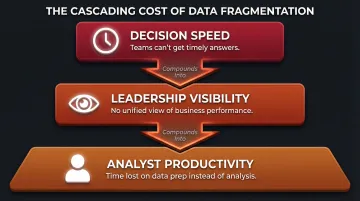
Fragmentation creates damage across three layers:
- Teams can't get answers fast enough to make timely decisions
- Leadership operates without a unified view of business performance
- Data scientists and analysts spend time on data preparation instead of actual analysis
The tools below reduce that manual burden—giving teams faster access to clean, reliable data without rebuilding pipelines from scratch.
Best AI Tools for Centralizing Business Data
These tools were selected based on their ability to connect diverse data sources, deliver AI-powered querying or automation, maintain enterprise-grade security, and reduce manual effort for data and business teams.
Sylus
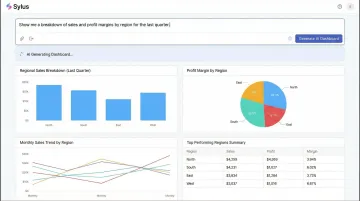
Sylus is an AI data analytics platform that connects directly to a business's data sources—including databases and dbt models—and allows any team member to ask questions in plain English and receive validated, dashboard-ready answers. It is SOC 2 Type II and HIPAA compliant, supports self-hosted deployment, and offers unlimited seats on usage-based pricing, making it accessible for both fast-growing startups and enterprise data teams.
What makes Sylus stand out for data centralization is its "governed context" architecture. Every AI query is grounded in the company's own dbt models and documentation, preventing hallucinations and ensuring metric consistency across teams.
When a business user asks "What were total sales for each sales rep from the last 12 months?", Sylus references validated dbt models rather than making assumptions about data structure. This governance layer is what separates accurate answers from fast-but-wrong ones.
Key capabilities include:
- AI-generated dashboards that automatically visualize connected data sources
- Slack integration for querying data directly in chat without switching tools
- Scheduled report delivery to email or Slack with AI-generated summaries
- Anomaly alerts that notify teams of spikes or significant changes
- Shareable collections for organizing reports by audience (board KPIs, sales assets, etc.)
Sylus guarantees that neither the platform nor its model partners train on customer data, addressing a critical concern for enterprises handling sensitive information. The platform supports over 500 data source integrations and connects seamlessly with existing data warehouses.
| Feature | Details |
|---|---|
| Key Features | Plain-English querying grounded in dbt models, AI-generated dashboards, Slack query integration, scheduled reports and summaries, anomaly alerts, shareable collections |
| Best For | Data teams and business users at startups and enterprises that use dbt and need governed, self-serve analytics without adding analyst headcount |
| Pricing / Deployment | Usage-based pricing with unlimited seats; cloud and self-hosted deployment available; SOC 2 Type II and HIPAA compliant |
Fivetran
Fivetran is a managed data pipeline platform that automates the extraction and loading of data from hundreds of SaaS tools, databases, and APIs into a centralized data warehouse such as Snowflake, BigQuery, or Databricks. The platform offers over 700 fully managed connectors and more than 200 activation destinations—covering more source-to-destination combinations than most competing pipeline tools.
Fivetran stands out for data centralization through fully automated schema migration, pre-built connectors that require zero maintenance, and reliable change data capture (CDC) for near-real-time syncing. Data teams spend time analyzing data rather than building and maintaining pipelines. When a source system changes its schema, Fivetran automatically adapts without breaking downstream reports—an essential safeguard for organizations managing dozens of data sources.
The platform uses a consumption-based pricing model based on Monthly Active Rows (MAR), with tiers ranging from a free plan (up to 500,000 MAR) to Enterprise and Business Critical levels that include 1-minute syncs and customer-managed encryption keys.
| Feature | Details |
|---|---|
| Key Features | Automated ELT pipelines, 700+ pre-built connectors, schema drift handling, CDC for real-time sync, data warehouse support |
| Best For | Engineering and data teams that need a reliable, low-maintenance pipeline layer to feed a central data warehouse |
| Pricing / Deployment | Monthly active rows (MAR) pricing model; cloud-hosted; free tier available up to 500,000 MAR |
ThoughtSpot
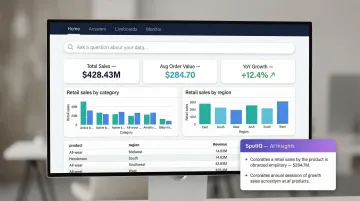
ThoughtSpot is a search-driven analytics platform that allows business users to query data using natural language and receive AI-powered insights through "Liveboards"—dynamic, shareable views of key metrics drawn from a connected data warehouse. The platform holds a 4.4 out of 5-star rating on G2 and was named a Leader in the 2025 Gartner Magic Quadrant for Analytics and BI Platforms.
ThoughtSpot's differentiator is its SpotIQ AI engine, which proactively surfaces anomalies, trends, and correlations that users may not have thought to ask about—shifting analytics from reactive querying to proactive insight delivery.
Key capabilities include:
- SpotIQ AI engine for automatic anomaly detection and trend surfacing
- Spotter AI Analyst agent for plain-English business questions with explainable answers
- Liveboards for dynamic, shareable metric views tied directly to warehouse data
- Embedded analytics for deploying insights inside external products and portals
Notable enterprise clients include Coca-Cola, Hilton Worldwide, and Capital One. Pricing starts at $25 per user/month for the Developer tier and $50 per user/month for the Team tier, with Enterprise pricing available through sales contact.
| Feature | Details |
|---|---|
| Key Features | Natural language search queries, Liveboards, SpotIQ AI-generated insights, anomaly detection, embedded analytics |
| Best For | Business users and analytics teams who need self-serve, search-style exploration of centralized warehouse data without writing SQL |
| Pricing / Deployment | Cloud and software; Developer tier starts at $25/user/month, Team tier at $50/user/month, Enterprise tier custom |
MuleSoft
MuleSoft (a Salesforce company) is an enterprise integration platform that connects legacy systems, modern SaaS applications, databases, and APIs into a unified data fabric—enabling organizations to centralize data flows without replacing existing infrastructure. The Anypoint Platform provides hundreds of pre-built connectors to popular systems, services, and LLMs through Anypoint Exchange.
MuleSoft's differentiator for large organizations is its Agent Fabric layer, which allows AI agents (including third-party models) to be orchestrated across a company's entire data ecosystem. This makes it the connectivity backbone for enterprises deploying AI at scale. The platform supports deployment in virtually any environment, including CloudHub (fully managed cloud) and Anypoint Runtime Fabric for containers on AWS, Azure, GCP, and on-premises.
MuleSoft was recognized as a Leader in the Gartner Magic Quadrant for API Management for the 10th consecutive time, a consistent track record in large-scale enterprise integration.
| Feature | Details |
|---|---|
| Key Features | API-led connectivity, pre-built connectors, event-driven integration, Agent Fabric for AI orchestration, real-time and batch data flows |
| Best For | Large enterprises with complex legacy infrastructure that need to unify data across dozens of systems before applying AI analytics |
| Pricing / Deployment | Enterprise licensing; contact Salesforce/MuleSoft for pricing; available as cloud or hybrid deployment |
Tableau
Tableau (a Salesforce company) holds approximately 16.7% to 16.99% of the BI market share, making it one of the most broadly deployed business intelligence platforms available. The platform offers interactive data visualization, centralized metric management, and AI-powered natural language features (Tableau Pulse and Ask Data) that allow users to query data and receive contextual narrative explanations of trends.
Tableau's strength for centralization lies in its Data Management Add-on and Tableau Catalog, which create a governed, searchable inventory of all connected data assets across the organization. This gives data teams visibility into what data exists, where it lives, and how it's being used across dashboards—critical for maintaining data quality and preventing metric inconsistencies.
Tableau was named a Leader in the 2024 Gartner Magic Quadrant for Analytics and BI Platforms for the 12th consecutive year. Pricing is seat-based: Creator at $75 per user/month (includes Tableau Desktop and Prep Builder), Explorer at $42 per user/month (web-based editing), and Viewer at $15 per user/month (read-only access).
| Feature | Details |
|---|---|
| Key Features | Interactive dashboards, Tableau Pulse AI narratives, Ask Data NLP querying, Tableau Catalog, embedded analytics, prep and data management tools |
| Best For | Organizations that already have centralized data warehouses and need a governed, visual analytics layer accessible to both technical and business users |
| Pricing / Deployment | Per-creator ($75/month) and per-viewer ($15/month) seat pricing; cloud (Tableau Cloud) and on-premises (Tableau Server) |
How We Chose the Best AI Tools for Data Centralization
Tools were assessed based on their ability to reduce manual data work at scale, not just automate a single step. A common mistake buyers make is evaluating tools based on interface or demo impressions without auditing whether the tool addresses the full data lifecycle—from ingestion to insight delivery.
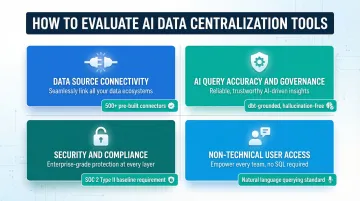
Four selection criteria guided this evaluation:
1. Data source connectivity breadth: Tools with 500+ pre-built connectors (like Fivetran and Sylus) eliminate custom integration work, while enterprise platforms (like MuleSoft) handle complex legacy system connectivity.
2. AI query accuracy and governance: Governed tools like Sylus use dbt models as the source of truth; platforms like ThoughtSpot and Tableau provide catalog-based governance to maintain metric consistency and prevent AI hallucinations.
3. Security and compliance posture: According to the 2025 SaaS Security Report, SOC 2 Type II is now a baseline entry requirement, with 43% of buyers disqualifying vendors that can't provide verifiable credentials.
4. Accessibility for non-technical users: Natural language querying is now standard practice — over 50% of organizations already use AI tools for automated insights and NLQ, making SQL-free access an expected baseline, not a differentiator.
Every tool reviewed here scored well on integration depth and deployment flexibility (cloud vs. self-hosted) — two factors that directly shape total cost of ownership and how quickly a team can go from setup to insight.
Conclusion
Centralizing business data is no longer just an engineering problem—it's a business strategy decision. The right tool should match the organization's current data maturity, team composition, and compliance requirements, not just the most prominent brand name.
Start by identifying where time is actually being lost — in data movement, in querying, or in reporting. That bottleneck points directly to the tool category you need:
- Pipeline bottleneck: A dedicated tool like Fivetran gets data into your warehouse reliably
- Access bottleneck: ThoughtSpot or Tableau give business users search-driven interfaces that don't require SQL
- Governance bottleneck: Sylus connects directly to dbt models and generates validated dashboards automatically, without adding analyst headcount
The teams that get the most from data centralization are the ones that pick tools based on their actual constraints, not trend reports. Connect your data sources to Sylus and start asking questions in plain English today.
Frequently Asked Questions
What is the best AI tool for business analytics?
The right choice depends on what your team needs: data pipeline infrastructure, natural language querying on an existing warehouse, or a governed AI analyst that generates dashboards automatically. For example, Sylus excels at dbt-based analytics with unlimited seats, while ThoughtSpot focuses on search-driven exploration — different use cases, not competing ones.
Can AI agents handle unstructured data?
Modern AI agents can process semi-structured and unstructured data (emails, PDFs, logs) through preprocessing layers, but accuracy improves when data is structured and governed beforehand. Most enterprise tools perform best with warehouse data paired with defined business logic — which is why platforms like Sylus ground queries in dbt models rather than raw sources.
What is the difference between a data integration tool and an AI analytics tool?
Integration tools (like Fivetran or MuleSoft) move data from source systems into a central location; AI analytics tools (like Sylus or ThoughtSpot) let users query and analyze it. Most organizations need both: integration to consolidate data, analytics to make it actionable.
How do AI tools for data centralization handle security and compliance?
Enterprise-grade tools offer SOC 2 Type II, HIPAA, or ISO 27001 certifications, role-based access controls, and data masking. Sylus goes further with self-hosted deployment for air-gapped environments and a guarantee that customer data is never used to train AI models — a hard requirement for regulated industries.
Do I need a data warehouse before using an AI analytics tool?
Not strictly, but it helps. Most tools connect to an existing warehouse (Snowflake, BigQuery, Databricks), and a clean, centralized warehouse meaningfully improves AI query accuracy and reduces errors. Tools that integrate with dbt, like Sylus, also leverage existing transformation logic — making warehouse-based setups more valuable over time.
How quickly can teams start getting insights after deploying an AI data tool?
It depends on data readiness. Simpler tools with pre-built connectors can deliver first insights within hours; enterprise deployments with governance layers typically take days to weeks. Tools that connect to existing dbt documentation, like Sylus, cut ramp-up time by building on already-defined business logic.