Introduction
Modern data teams face a critical bottleneck: business users wait days for SQL-based answers while analysts drown in ad hoc requests. This friction costs organizations time, money, and competitive advantage. AI-driven conversational query tools are collapsing that gap in 2026, enabling users to ask questions in plain English and receive instant, accurate insights without writing a single line of code.
Worldwide spending on AI is forecast to reach $2.52 trillion in 2026 — a 44% year-over-year increase. The conversational AI market alone is projected to hit $41.39 billion by 2030, growing at a 23.7% compound annual rate.
Organizations are moving beyond static dashboards toward agentic workflows where AI autonomously investigates data, surfaces anomalies, and validates assumptions before surfacing results.
This article covers what conversational data query tools are, the top solutions for 2026, and the key criteria for choosing the right platform for your stack and governance requirements.
Key Takeaways
- Conversational data query tools translate plain-English questions into database queries, returning charts and insights without any SQL knowledge
- Governed context is the biggest 2026 differentiator—AI grounded in trusted data definitions, not raw schemas
- Key selection criteria: hallucination controls, governance features, dbt/semantic layer integration, SOC 2/HIPAA certifications, and deployment flexibility
- Top solutions: Sylus, Zenlytic, ThoughtSpot, Microsoft Power BI with Copilot, Looker with Gemini, Tableau Pulse
- The best tool depends on your stack, team's technical depth, and governance requirements
What Are AI-Driven Conversational Data Query Tools?
Conversational data query tools are software platforms that let users ask questions about structured business data in plain English and receive accurate answers—charts, tables, or summaries—without writing code or SQL. Instead of waiting for analysts to build reports, business users engage in dynamic dialogue with their data, drilling down or pivoting with follow-up questions as new ones arise.
How They Differ from Traditional BI
Traditional BI dashboards are pre-built, static reports that require analyst setup and maintenance. Users can only view what's been configured in advance. Conversational tools flip this model: users ask new questions in real time and receive immediate answers, making data exploration accessible to anyone regardless of technical skill.
The Technology Behind Conversational Analytics
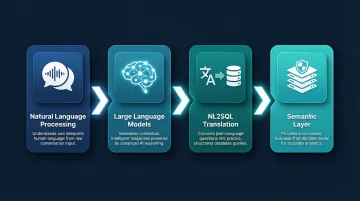
These platforms rely on several key technologies:
- Natural Language Processing (NLP) — Interprets user intent from plain-English questions
- Large Language Models (LLMs) — Understand context and generate human-like responses
- NL2SQL Translation — Converts natural language into structured SQL queries
- Semantic Layers — Provide governed business logic and metric definitions
The Critical Governance Challenge
Those four technologies are only as reliable as the context they're grounded in. LLMs can hallucinate — and the gap shows up fast in real enterprise environments. On the Spider 2.0 benchmark, which features complex 1,000+ column schemas, accuracy drops to just 10.1% for GPT-4o and 21.3% for advanced reasoning models. Without a grounded semantic layer, AI-generated answers can be confidently wrong.
Routing LLM queries through a semantic layer like LookML or dbt MetricFlow reduces data errors by up to 66%, according to Google's internal testing. The best platforms anchor their AI in trusted, documented business context rather than generating answers directly from raw table schemas — which is why governed context has become the defining differentiator among 2026 tools.
Top AI-Driven Conversational Data Query Tools for 2026
Each tool below was evaluated across five criteria:
- NL2SQL accuracy — how reliably natural language translates to correct queries
- Governance and security posture — data controls, compliance certifications, and deployment options
- Integration depth — compatibility with modern data stacks (warehouses, semantic layers, dbt)
- Deployment flexibility — cloud, self-hosted, and hybrid options
- Real-world usability — for both technical and non-technical users
Sylus
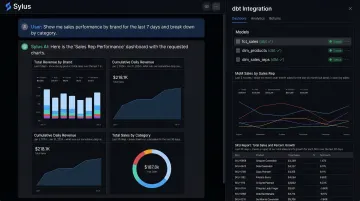
Sylus is an enterprise analytics platform built for modern data teams, serving customers including OpenAI. It connects to existing data sources and answers questions in plain English—an AI data analyst positioned as "ChatGPT, but trained on your business's data."
What separates Sylus from general-purpose BI tools is its governed context architecture. Every query and analysis is grounded in the team's dbt models and documentation. The AI validates assumptions and explores the data thoroughly before returning a final answer, which keeps hallucination risk low even on complex business questions.
| Category | Details |
|---|---|
| Key Features | Governed context via dbt models; AI-generated dashboards; Slack querying; scheduled reports and AI summaries; team collaboration for metric verification; alerts on data spikes; unlimited seats |
| Security & Compliance | SOC 2 Type II certified; HIPAA compliant; self-hosted deployment available; Sylus and model partners do not train on customer data |
| Pricing Model | Usage-based pricing with unlimited seats |
Zenlytic
Zenlytic is an AI data analyst platform (led by "Zoë") built for mid-market to enterprise teams, with explainability at its core through the Clarity Engine—which translates AI-generated SQL into human-readable metric explanations with full data lineage citations.
Key Differentiator: The "Memories" feature ensures consistent answers to the same question over time, and Citations show exactly where every number came from. For teams where auditability is non-negotiable, this combination addresses the two most common objections to AI-generated analytics: inconsistency and opacity.
| Category | Details |
|---|---|
| Key Features | Zoë AI analyst; Clarity Engine for explainability; Memories for answer consistency; Citations for data lineage; enterprise governance and row-level security |
| Integrations | Snowflake, BigQuery, Redshift, Databricks; semantic layer support |
| Best For | Teams prioritizing explainability, trust, and deep exploratory analysis |
ThoughtSpot
ThoughtSpot is a pioneer in search-driven analytics, offering a "Google for data" experience where business users type natural language questions and receive instant visualizations through its Spotter AI interface.
Trade-off: ThoughtSpot excels at intuitive data exploration but requires significant upfront data modeling work by the data team before users can query effectively, making initial setup more demanding than newer purpose-built tools.
| Category | Details |
|---|---|
| Key Features | Natural language search (Spotter); AI-generated visualizations; ThoughtSpot Everywhere for embedded analytics |
| Integrations | Major cloud warehouses (Snowflake, BigQuery, Redshift); Salesforce, dbt |
| Best For | Teams wanting a familiar search-style interface for fast data exploration |
Microsoft Power BI with Copilot
Power BI with Copilot is Microsoft's AI-augmented BI platform, integrating natural language reporting and Q&A directly into the Microsoft 365 and Azure ecosystem—making it a natural fit for enterprises already committed to Microsoft infrastructure.
Key Limitation: Copilot's most advanced conversational features require Microsoft Fabric or Premium licensing (F2 or higher, P1 or higher); standard Pro or Premium Per User licenses are insufficient. The AI layer feels like an add-on rather than a native interface, and complex questions still require DAX knowledge.
| Category | Details |
|---|---|
| Key Features | Natural language report generation; Copilot-assisted dashboard building; Azure integration; DAX query support |
| Integrations | Azure Synapse, OneLake, Microsoft 365, Dynamics 365 |
| Best For | Organizations deeply embedded in the Microsoft ecosystem |
Looker with Gemini
Looker is Google Cloud's cloud-native BI platform, now augmented with Gemini AI for conversational querying—enabling natural language questions that generate LookML-based queries and Looker Studio visualizations directly within the Google Cloud environment.
Learning Curve: Looker's LookML modeling language requires technical resources to build and maintain, meaning Gemini's conversational layer is most powerful for teams that have already invested in proper LookML modeling.
| Category | Details |
|---|---|
| Key Features | Gemini AI natural language queries; LookML semantic modeling; Looker Studio chart generation; cloud-native architecture |
| Integrations | BigQuery-native; Google Cloud ecosystem; supports other warehouses |
| Best For | Google Cloud users who need tight BigQuery integration and conversational BI |
Tableau Pulse
Tableau Pulse is Salesforce's AI-enhanced addition to the Tableau platform, delivering proactive insights and natural language Q&A on top of Tableau's widely-trusted visualization and visual storytelling capabilities.
Key Consideration: Tableau's AI layer is strongest for exploring existing dashboards and receiving proactive metric nudges, but true open-ended exploratory querying requires significant semantic setup and works better as a complement to Tableau's core visual BI than as a standalone conversational tool.
| Category | Details |
|---|---|
| Key Features | Proactive metric insights; natural language Q&A on dashboards; AI-generated summaries; Tableau's visualization engine |
| Integrations | Salesforce Data Cloud, Snowflake, Redshift, Google BigQuery |
| Best For | Teams already invested in Tableau who want to add AI-assisted insights |
How We Chose the Best Conversational Data Query Tools
Tools were assessed on NL2SQL accuracy and hallucination risk, governance and security posture, depth of integration with modern data stacks (dbt, cloud warehouses), and ease of adoption for non-technical users.
The Accuracy Reality Check
While large language models score between 73.0% and 91.2% on classic NL2SQL benchmarks, their performance plummets in real-world enterprise environments. Research shows a 25% failure rate caused specifically by semantic translation errors, and when faced with ambiguous queries, LLMs tend to hallucinate plausible-looking but semantically incorrect SQL rather than asking for clarification.
The Most Common Selection Mistake
Buyers choose tools based on demo performance on clean, curated data rather than testing against their actual messy, undocumented warehouse. Governance features—semantic layers, dbt context, row-level security—are what separate reliable production tools from polished demos.
Additional Decision Factors
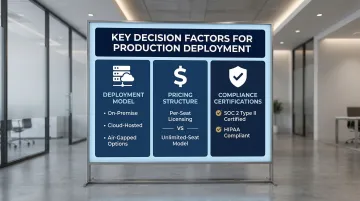
Three factors consistently separate good demos from reliable production deployments:
- Deployment model: Healthcare and finance teams often need on-premise or air-gapped options. Under HHS guidance, cloud providers processing encrypted ePHI are still considered HIPAA Business Associates — requiring formal BAAs even for "no-view" services.
- Pricing structure: Per-seat models become expensive fast. Unlimited-seat pricing (like Sylus uses) keeps costs predictable as adoption spreads across the organization.
- Compliance certifications: SOC 2 Type II and HIPAA compliance are non-negotiable for healthcare, finance, and enterprise data teams. SOC 2 Type II examinations cover security, availability, processing integrity, confidentiality, and privacy controls in detail.
Conclusion
In 2026, the gap between conversational data query tools is less about NLP capability and more about governance. The best platforms ground their AI in trusted, documented context rather than generating answers from raw table schemas. According to the 2024 State of Analytics Engineering report, 57% of data professionals cite poor data quality as a predominant issue — which is exactly why governed context matters when you're trusting AI to answer business-critical questions.
Test tools against real-world questions from your own data, evaluate security and compliance fit, and factor in long-term scalability. On that last point: as adoption spreads across your org, per-user pricing can quietly eat into value — unlimited seat models keep costs predictable as usage grows.
For teams looking for a governed, enterprise-ready conversational data query tool—especially those already using dbt—Sylus is built specifically for this: grounding every query in your dbt models and documentation so AI answers are traceable, not guesswork. Explore Sylus and schedule a demo to connect your data sources and see results firsthand.
Frequently Asked Questions
What is a conversational data query tool?
A conversational data query tool is an AI-powered platform that lets users ask questions about their business data in plain English and receive answers (charts, tables, summaries) without writing SQL or code. These tools use NLP and LLM technology to translate natural language into database queries.
How do AI-driven data query tools handle data governance and security?
Most platforms use semantic layers, row-level permissions, and audit trails to control data access. Enterprise-grade tools offer SOC 2 or HIPAA compliance, and some provide self-hosted deployment so customer data never leaves the organization's infrastructure.
What is the difference between a conversational query tool and a traditional BI dashboard?
Traditional BI dashboards are pre-built, static reports requiring analyst setup, while conversational query tools allow dynamic, open-ended dialogue with data. Users ask new questions in real time without waiting for a dashboard to be built.
How accurate are AI-generated answers from natural language data queries?
Accuracy varies significantly by platform and depends heavily on how well the underlying data is documented. Tools grounded in semantic layers or dbt models produce more reliable answers than tools querying raw schemas directly. Without governance, accuracy can drop to just 10% on complex enterprise schemas.
Do I need a data engineering team to set up a conversational query tool?
Setup requirements vary. Some tools (like ThoughtSpot or Looker) require significant upfront modeling by data engineers, while others connect to existing data sources and dbt models with minimal configuration, reducing the burden on your data team.
Can conversational data query tools integrate with dbt and cloud data warehouses?
Most modern tools support major cloud warehouses (Snowflake, BigQuery, Redshift, Databricks). A growing number also natively integrate with dbt's semantic layer to inherit metric definitions and governance rules already built by the data team.