Introduction
The average enterprise manages 897 applications, yet only 29% are integrated. This fragmentation creates data silos that cost organizations an average of $12.9 million annually in poor data quality alone. When teams rely on disconnected spreadsheets, standalone BI software, and separate databases, they face conflicting metrics, slow decision cycles, and frustration across both technical and non-technical teams.
A data analytics platform solves this by bringing data collection, processing, analysis, and visualization under one roof. Unlike stitching together multiple tools, modern platforms provide a unified environment where data flows from source to insight without translation loss or version conflicts.
The analytics landscape is shifting rapidly. AI-native platforms now let anyone—not just data analysts—query data in plain English and get answers in seconds, putting insights directly in the hands of the people who act on them.
TLDR:
- Data analytics platforms unify data collection, processing, analysis, and visualization in one environment
- Modern platforms support five analytics types: descriptive, diagnostic, predictive, prescriptive, and AI-augmented
- Essential features: 500+ integrations, natural language querying, governed context, and SOC 2/HIPAA compliance
- Organizations reduce integration timelines by 50-70% and cut IT data requests by 40-60% with modern platforms
- Choose platforms with AI-native capabilities, unlimited seats, and deployment flexibility for long-term scalability
What Is a Data Analytics Platform?
A data analytics platform is an integrated software solution that lets organizations collect, process, analyze, and visualize data from multiple sources in one place. The older approach meant juggling separate tools for ETL, storage, and visualization. Platforms collapse that complexity into a single environment.
The key distinction between a data analytics platform and a standalone BI tool is scope. BI tools focus on visualization and reporting — presenting pre-processed data through dashboards and charts. Platforms are end-to-end solutions: they connect natively to data sources, transform and prepare data, enable advanced analytics, and support cross-team collaboration within a scalable architecture built for enterprise use.
Gartner defines Analytics and Business Intelligence platforms as solutions that "enable organizations to model, analyze and visualize data to support informed decision making and value creation." These platforms "facilitate the preparation of data and the creation of interactive dashboards, reports and visualizations" and may include the ability to create or enrich a semantic model with business rules.
Who uses these platforms? Roles vary, but the underlying need is the same: turn raw data into reliable decisions, faster.
- Data engineers build and maintain the pipelines that keep data flowing
- Analysts explore datasets, test hypotheses, and surface insights
- Business users across sales, marketing, finance, and operations track performance and answer operational questions
That demand is reshaping the market. According to IDC, worldwide revenue for AI platform software will reach $153.0 billion by 2028 — a 40.6% compound annual growth rate.
Types of Data Analytics
Understanding the types of analytics a platform supports is critical when evaluating solutions. Modern platforms go beyond historical reporting to enable predictive and prescriptive capabilities that drive real decisions.
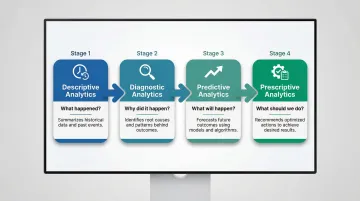
The four core types of data analytics:
- Descriptive analytics answers "What happened?" by tracking historical data through dashboards, BI tools, and visualizations
- Diagnostic analytics answers "Why did it happen?" by drilling down into data to understand key relationships and past behaviors
- Predictive analytics answers "What will happen?" using statistical algorithms and machine learning to forecast probabilities and future outcomes
- Prescriptive analytics answers "What should we do?" by applying rule-based approaches and optimization techniques to recommend the best course of action
AI-Augmented Analytics: The Fifth Type
A fifth type is emerging: cognitive and AI-augmented analytics. It answers "What don't I know to ask?" by integrating natural language processing and machine learning to automate data preparation, insight generation, and explanation. AI models proactively explore data, surface anomalies, validate assumptions, and generate summaries without human prompting.
A TDWI survey found that 62% of respondents already use commercial generative BI products, and 25% plan to build their own. This shift separates AI-native platforms from legacy tools limited to descriptive and diagnostic analytics.
Teams relying only on descriptive analytics are always looking backward. Platforms that support all five types let organizations spot risks and opportunities as they emerge — not after the fact.
Key Features to Look For in a Data Analytics Platform
Data Integration and Connectivity
The platform should connect to a wide range of data sources—databases, data warehouses, cloud storage, APIs—without requiring complex engineering effort. Leading enterprise platforms document extensive native connectivity: Domo offers 1,000+ pre-built connectors, Sisense provides 400+ connectors, and Microsoft Power BI features a massive library spanning Azure services, databases, and SaaS applications.
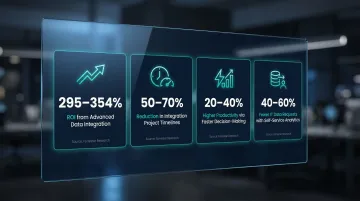
Integration complexity severely impacts project timelines. Gartner analysis shows that 85% of big data projects fail, often due to technical challenges and compounding complexity. Organizations that successfully implement advanced data integration platforms achieve 295% to 354% ROI and reduce integration project timelines by 50-70%, according to Forrester TEI studies.
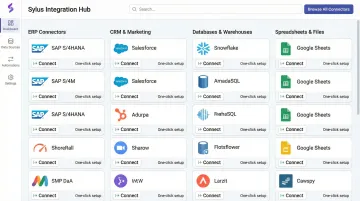
Platforms like Sylus support 500+ pre-built integrations across a broad range of systems—enabling one-click connectivity without manual API configuration:
- ERP and accounting platforms
- CRM systems and e-commerce tools
- Databases and cloud data warehouses
- Spreadsheets and developer APIs
Natural Language Querying and AI-Assisted Analysis
Natural language querying has become a baseline expectation, not a bonus feature—it's what extends analytics access beyond the data team to every business user. Modern platforms let users ask questions in plain English and receive validated answers, full dashboards, and AI-generated summaries without writing SQL or code.
Gartner predicts that by 2026, 90% of current analytics content consumers will become content creators enabled by AI. Separately, 40% of enterprise applications will be integrated with task-specific AI agents by the end of 2026, up from less than 5% today.
Platforms like Sylus enable users to type questions such as "show me my top customers" or "what were total sales for each sales rep from the last 12 months?" and receive instant visualizations with formatted results. The AI thoroughly explores data and validates assumptions before returning final deliverables.
This capability transforms business users from passive dashboard consumers into active data explorers, reducing IT data requests by 40-60% and freeing data teams to focus on higher-value work.
Governed Context and Data Trust
AI outputs are only as trustworthy as the business logic behind them. Quality platforms ground analysis in verified definitions—dbt models and documentation—so every insight aligns with how the company actually measures its metrics, not how different teams happen to calculate them.
According to the dbt Labs 2025 State of Analytics Engineering Report, poor data quality remains the challenge most frequently reported by data teams, cited by over 56% of respondents. When departments present conflicting facts about identical business realities, valuable executive time disappears into reconciliation exercises, eroding confidence in data-driven decision-making.
Gartner predicts that by 2030, universal semantic layers will be treated as critical infrastructure alongside data platforms and cybersecurity. Tools like dbt are becoming standard; 76% of respondents in a dbt Labs survey work for companies using dbt to transform, test, and document data in the cloud data warehouse.
Sylus builds on governed context by grounding all analysis and exploration in dbt models and dbt documentation, ensuring that every query, visualization, and insight is validated against documented business logic. This eliminates metric conflicts and builds organizational trust in AI-generated insights.
Dashboard Creation and Visualization
The platform should auto-generate and customize charts, dashboards, and shareable reports. Leading platforms support bar charts, line graphs, pie charts, and tables, with AI-powered chart recommendations that suggest the most appropriate visualization based on dataset structure.
Modern platforms enable customization through plain English instructions. Users can request modifications conversationally—such as adjusting color schemes, filtering data ranges, or changing chart types—without navigating complex configuration menus. Dashboards should support multiple delivery options:
- Shareable links or email invitations
- Embedded directly into websites and products
- Scheduled delivery via email or Slack
Sylus auto-generates entire dashboards displaying key metrics such as total revenue, average order value, monthly revenue trends, and sales representative performance, allowing teams to monitor business health without manual dashboard construction.
Security, Compliance, and Deployment Flexibility
Enterprise-critical requirements include SOC 2 Type II and HIPAA compliance, role-based access controls, data encryption, and self-hosted deployment options for organizations with strict data residency requirements.
SOC 2 Type II evaluates both the design and operating effectiveness of a company's security controls over a specific period (usually 3 to 12 months), based on five Trust Services Criteria: Security, Availability, Processing Integrity, Confidentiality, and Privacy.
HIPAA compliance classifies cloud/SaaS providers that create, receive, maintain, or transmit electronic Protected Health Information (ePHI) as "Business Associates," requiring a signed Business Associate Agreement (BAA) and strict administrative, physical, and technical safeguards.
According to Gartner, concerns about security and cyberattacks are a top trigger of software investments for 47% of buyers. Platforms lacking these certifications are non-starters for regulated industries.
Sylus is SOC 2 Type II compliant and HIPAA compliant, with self-hosted deployment available for organizations requiring air-gapped environments. Critically, neither Sylus nor its model partners train models on customer data, ensuring proprietary information remains confidential.
Benefits of Using a Data Analytics Platform
Faster Time to Insight
Traditional workflows require hours or days to pull a report—requiring SQL knowledge, IT tickets, or analyst queues. Modern platforms enable answers in seconds. TDWI reports that data teams still spend 80% of their time looking for and preparing data, leaving just 20% for actual analysis.
The business cost of this decision latency is massive. McKinsey research shows that executives spend almost 40% of their time making decisions and believe most of that time is poorly used. Inefficient decision-making costs a typical Fortune 500 company 530,000 days of managers' time each year, equivalent to about $250 million in annual wages.
That lost time has a measurable upside: faster decision-making correlates with 20-40% higher productivity and performance. Organizations implementing modern analytics platforms report a 50-70% reduction in integration project timelines, according to Forrester Total Economic Impact studies.
Eliminating Data Silos and Enabling Collaboration
Centralizing data from multiple sources removes the fragmentation that leads to conflicting metrics and slow decisions. DATAVERSITY research found that 68% of organizations cite data silos as their top concern, with McKinsey estimating that data silos cost businesses an average of $3.1 trillion annually in lost revenue and productivity.
The human cost is just as significant. Forrester research finds that knowledge workers spend an average of 12 hours a week chasing data across disconnected systems — time that compounds into weeks of lost productivity each quarter.
Modern platforms break down these barriers by unifying data into a single environment. Collaboration features like metric verification, shared collections, and team-based validation ensure everyone works from the same definitions, eliminating reconciliation exercises and building confidence in data-driven decisions.
Empowering Non-Technical Business Users
AI-driven platforms remove the bottleneck of needing a data analyst for every question. Sales, marketing, finance, and ops teams can self-serve answers, freeing data teams to focus on higher-value work.
Currently, over 72% of BI requests remain unresolved for more than a week, creating backlogs that block managers and executives. Self-service analytics directly solves this bottleneck, reducing IT data requests by 40-60%.
Platforms with natural language interfaces enable business users to ask questions conversationally and receive instant visualizations without SQL knowledge. TDWI predicts that by 2026, AI literacy will shift from a specialist skill to a core organizational competency — making self-service analytics less of an advantage and more of a baseline expectation.
Proactive Alerting and Decision-Making
Organizations don't just react to data—they get notified when something unusual happens so they can act before a problem compounds. Automated anomaly detection and spike alerts enable proactive decision-making.
Modern platforms handle this through:
- Spike and anomaly alerts sent via email or Slack when revenue, usage, or key metrics shift unexpectedly
- Scheduled AI-generated summaries delivered on a cadence, so teams stay informed without logging in
- Threshold-based triggers that flag changes before they become costly problems
Scalability Without Exponential Cost
Traditional per-seat pricing creates artificial barriers to adoption. According to Flexera, 85% of SaaS leaders are shifting to usage-based or hybrid pricing models — because seat-based pricing assumes predictable usage, while AI workloads scale by tokens, compute minutes, and model complexity.
Unlimited-seat pricing lets organizations expand access without budget surprises. Growing teams, variable usage patterns, and cross-functional needs all scale without linear cost increases.
Sylus is built on this model: unlimited seats priced on estimated usage, with SOC 2 Type II compliance, HIPAA compliance, and a self-hosted deployment option for teams with strict data residency requirements.
How to Choose the Right Data Analytics Platform
Align the Platform with Your Data Strategy and Team Structure
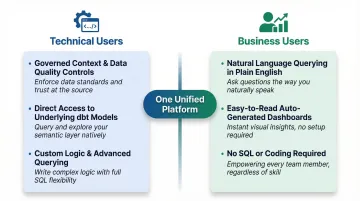
Ask whether the platform serves both technical users (data engineers, analysts) and business users equally well. Self-service capabilities and governed outputs are key signals. Evaluate whether the platform integrates with your existing data stack—such as dbt, Snowflake, or BigQuery—to avoid rip-and-replace implementations.
The best platforms serve both groups without creating separate capability tiers:
- Technical users need governed context, data quality controls, and direct access to underlying models
- Business users need natural language querying and easy-to-read dashboards
- Neither group should be forced into rigid workflows built for the other
Evaluate AI Capabilities Critically
Not all "AI analytics" is equal. Distinguish between platforms that bolt AI on top of traditional BI versus those built AI-natively from the ground up.
Key questions to ask:
- Does the AI validate assumptions before returning results?
- Is analysis grounded in your business's own data models and documentation?
- Can you query via Slack or other tools your team already uses?
- Does the platform support cognitive analytics that proactively surfaces insights?
Sylus is built specifically around these principles—with governed context grounded in dbt models, leading AI models, and natural language querying at its core. The platform thoroughly explores data and validates assumptions before delivering final results.
Assess Security, Compliance, and Deployment Options
For regulated industries or enterprises with data sensitivity requirements, confirm the platform is SOC 2 Type II certified and HIPAA compliant at minimum. Determine whether a self-hosted option exists for teams that cannot send data to third-party cloud environments, and verify that the vendor does not train AI models on customer data.
Sylus meets these requirements out of the box:
- Cloud and self-hosted deployment options
- SOC 2 Type II and HIPAA compliant
- Explicit IP protection policy — neither Sylus nor its model partners train on customer data
Calculate True Total Cost of Ownership
Go beyond the listed subscription price — factor in per-seat licensing at scale, data egress fees, implementation effort, and the analyst hours lost to manual requests.
A platform with unlimited seats and usage-based pricing may cost significantly less at scale than per-seat tools. Hybrid pricing, which pairs a predictable base subscription with scalable usage limits, is gaining traction because it gives finance teams cost predictability while accommodating heavy query workloads and embedded analytics.
Frequently Asked Questions
What are data analytics platforms?
Data analytics platforms are integrated software solutions that allow organizations to collect, process, analyze, and visualize data from multiple sources in one place, enabling faster, more reliable, data-driven decisions across the business.
What are the 5 big data analytics?
The five types are descriptive (what happened), diagnostic (why it happened), predictive (what will happen), prescriptive (what should be done), and cognitive/AI-augmented analytics (automated insight generation and anomaly detection).
Which is the best platform for data analytics?
The right platform depends on your team's technical maturity, data stack, and compliance requirements. Prioritize integration breadth, AI validation capabilities, governance features, and security certifications — platforms like Sylus are built specifically for teams that need all of these without the setup complexity.
What is the difference between a data analytics platform and a BI tool?
BI tools are typically limited to visualization and reporting, while a data analytics platform is end-to-end—covering data integration, processing, governance, advanced analytics, and sharing in a unified environment.
Do data analytics platforms require coding knowledge to use?
Modern AI-native platforms let users query data in plain English, generate dashboards automatically, and surface insights without SQL or coding. Technical users can still go deeper — writing custom logic or querying directly from tools like Slack — when the need arises.
How do data analytics platforms handle data security and compliance?
Key certifications to require are SOC 2 Type II and HIPAA, alongside role-based access controls, encryption, and self-hosted deployment options. Sylus meets all of these standards and has a strict policy against training AI models on customer data.