Introduction
Most data teams in 2026 aren't short on data — they're short on time to use it. While 88% of enterprises now use AI regularly, data professionals still spend 80% of their time preparing data, leaving just 20% for actual analysis. That imbalance costs organizations time, revenue, and the ability to act before competitors do.
AI reporting tools are closing that gap. Modern platforms use machine learning and natural language processing to turn raw data into dashboards, summaries, and alerts — without waiting on an analyst to manually write queries or format charts. This post covers the top AI reporting tools in 2026, what separates them from traditional BI platforms, and how to choose the right one for your team's data maturity and compliance needs.
Key Takeaways
- AI reporting automates raw data into dashboards and alerts using natural language processing—no SQL required
- The best 2026 tools validate assumptions and integrate with your existing data stack—not just surface charts
- Key evaluation criteria: data integrations, natural language querying, compliance certifications, and self-serve capability
- Top platforms covered: Sylus (governed AI analytics), Tableau AI, Domo AI, Klipfolio, and Glean
- Startups should prioritize setup speed; enterprises should focus on governance and security
What Is AI Reporting and Why It Matters in 2026
AI reporting platforms interpret natural language questions, surface relevant data, detect anomalies, and generate narratives automatically—eliminating the manual query-building and chart-formatting that define traditional BI. Instead of analysts spending 60-80% of their time on manual reporting tasks, AI tools handle data retrieval, analysis, and visualization in seconds.
The business impact is measurable. According to McKinsey's 2025 State of AI report, 88% of organizations now use AI regularly in at least one business function, up from 78% the previous year. 62% of enterprises are also experimenting with AI agents—autonomous systems that execute multi-step workflows without human intervention.
Teams that delay adoption risk a real competitive gap: while they wait days for analyst availability, peers are answering business questions in real-time.
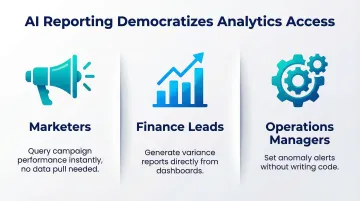
AI reporting also breaks analytics out of the hands of the traditional 20% of business users who could navigate SQL-based BI tools. Forrester predicts natural language querying and ML-based alerting will push adoption to 50%, bringing data access to teams that previously had none:
- Marketers can query campaign performance without waiting on a data pull
- Finance leads can generate variance reports directly from their dashboards
- Operations managers can set anomaly alerts without writing a single line of code
That's analytics shifting from a bottleneck to a distributed, self-serve function — and it's already happening.
Top AI Reporting Tools for Automated Analytics in 2026
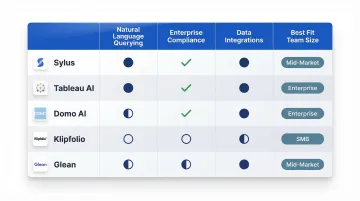
These tools were evaluated on depth of AI capability, data integrations, enterprise-readiness, security posture, and the ability to serve both technical and non-technical users—not just feature checklists.
Sylus
Sylus is an enterprise-grade AI analytics platform built for modern data teams. It connects directly to your data sources and lets users ask questions in plain English, with an AI analyst that explores data, validates assumptions, and returns a trusted final output. The platform is built on governed context using dbt models and documentation, grounding every analysis in verified business definitions rather than surfacing unvalidated results.
The unlimited-seat, usage-based pricing model makes it workable for fast-growing startups and F1000 enterprises alike. Customers include OpenAI. Full feature, security, and compliance details are in the table below.
| Attribute | Details |
|---|---|
| Key Features | Natural language querying, AI-generated dashboards, dbt-governed context, Slack integration, scheduled reports & summaries, anomaly alerts, team collaboration for metric verification |
| Security & Compliance | SOC 2 Type II certified, HIPAA compliant, self-hosted deployment available, no model training on customer data |
| Pricing Model | Unlimited seats; usage-based pricing—contact sales for specific tiers |
Tableau AI (Tableau Agent)
Tableau is a long-established leader in data visualization that has evolved significantly in 2026 by embedding an AI layer called Tableau Agent. This feature allows users to describe desired calculations or visualizations in natural language, which the system then translates into queries and visual outputs. The platform delivers automated data narratives and proactive insight delivery, letting non-technical users build visualizations and read narrative summaries without writing SQL.
Tableau AI is particularly strong for organizations already in the Salesforce ecosystem, offering deep integration and enterprise-grade security. However, it performs best with clean, well-structured data and may carry a steeper learning curve for new users compared to purpose-built AI platforms.
| Attribute | Details |
|---|---|
| Key Features | Natural language interface (Tableau Agent), automated data narratives, proactive insight delivery, visualization builder |
| Best Fit | Enterprises already using Salesforce; teams with structured, well-governed data sources |
| Pricing Model | Standard Edition: Viewer ($15/user/month), Explorer ($42/user/month), Creator ($75/user/month); Enterprise Edition: Viewer ($35), Explorer ($70), Creator ($115); Tableau Next AI add-on starts at $40/user/month |
Domo AI
Domo is a cloud-native data platform that combines data integration, AI-powered analytics, and an agentic AI layer called Agent Catalyst. This allows teams to build AI agents that can analyze data, generate reports, and trigger business workflows without deep technical setup. The platform's natural language processing layer makes it accessible to non-technical users, though initial onboarding can require effort.
Domo's strength lies in breadth of connectors (1,000+ pre-built integrations) and the ability to automate routine operations at scale. It's well-suited for mid-to-large enterprises needing to automate multi-step data workflows alongside reporting.
| Attribute | Details |
|---|---|
| Key Features | NLP-based reporting, Agent Catalyst for AI workflow automation, AI report generator, customizable dashboards |
| Best Fit | Mid-to-large enterprises needing to automate multi-step data workflows alongside reporting |
| Pricing Model | Standard, Business Critical, and Enterprise tiers—contact sales for pricing |
Klipfolio
Klipfolio is a cloud-based BI and dashboard platform with 130+ native data connectors—including Google Analytics, Salesforce, and HubSpot—that lets users consolidate data from multiple sources into real-time, customizable dashboards with minimal technical overhead. The platform supports automated report scheduling (PDF/shareable link) and drag-and-drop customization, making it a solid choice for SMBs and marketing teams.
Klipfolio offers more limited AI-driven analytics compared to purpose-built AI tools like Sylus or Domo, focusing instead on quick KPI visibility and ease of setup.
| Attribute | Details |
|---|---|
| Key Features | 130+ native connectors, drag-and-drop dashboards, automated scheduled reports, real-time KPI tracking |
| Best Fit | SMBs and marketing/ops teams needing quick KPI visibility without heavy data engineering |
| Pricing Model | PowerMetrics Launch: $18/month (2 users); Professional: $27.50/month (2 users); custom enterprise plans available |
Glean
Glean is an enterprise AI platform that integrates with 100+ business applications—including Salesforce, Jira, Slack, and Databricks—and allows users to query both structured and unstructured data using natural language in a single interface. It generates insight summaries across sources, making it possible to combine CRM data, messaging signals, and call transcripts in one query.
Glean's strength is cross-application intelligence, but it requires initial cross-departmental setup and optimal performance depends heavily on data quality across integrated sources. It's best suited for large enterprises needing to synthesize insights across many disconnected tools and departments.
| Attribute | Details |
|---|---|
| Key Features | 100+ app integrations, unified structured + unstructured data querying, NLP report generation, cross-platform insight summaries |
| Best Fit | Large enterprises needing to synthesize insights across many disconnected tools and departments |
| Pricing Model | Enterprise pricing—contact sales for details |
How We Chose the Best AI Reporting Tools
Most teams pick tools based on UI aesthetics or brand name. The tools above were assessed on factors that directly affect business outcomes — not just how a dashboard looks, but whether the AI behind it can be trusted.
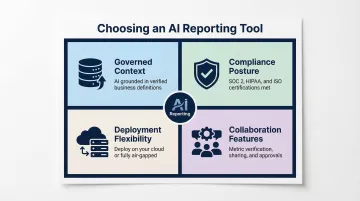
The criteria that matter most in 2026 for enterprise teams include:
- Governed context — Is the AI grounded in verified business definitions (like dbt models), or does it generate unvalidated outputs?
- Compliance posture — Does the platform hold SOC 2, HIPAA, or ISO certifications required for regulated industries?
- Deployment flexibility — Can you deploy in your own cloud environment or air-gapped infrastructure for maximum security?
- Collaboration features — Can teams verify metrics, comment on reports, and approve outputs before sharing externally?
The right tool depends on where your team sits on the data maturity curve. Smaller teams with lighter infrastructure often prioritize ease of setup (Klipfolio fits here). Data-mature enterprises, on the other hand, need AI that validates assumptions before surfacing results — not just generates them. That distinction matters: Sylus, for example, grounds every analysis in your dbt models and documentation rather than returning unverified outputs. Match your tool choice to your compliance requirements, deployment needs, and whether "good enough" answers are acceptable or not.
Conclusion
AI reporting tools in 2026 range from purpose-built governed analytics platforms to general-purpose BI tools with AI layers. The right choice depends on data maturity, team size, compliance requirements, and whether you need insights that are generated without verification or validated before delivery.
Evaluate tools not just on day-one demos but on scalability, pricing model as headcount grows, and how the tool handles data governance and security at the enterprise level. These factors compound over time. A tool that works for a 10-person team may become prohibitively expensive or impossible to govern at 100 people.
Those last two criteria — validated answers and governed context — are where most general-purpose BI tools fall short. Sylus is built specifically to address them: it explores your data, validates assumptions before surfacing answers, and grounds all analysis in your dbt models. It's free to get started, and teams from early-stage startups to OpenAI use it in production.
Frequently Asked Questions
Which is the best AI for reporting?
It depends on use case and team maturity. Sylus is purpose-built for data teams needing governed, validated analytics, while Tableau and Domo suit larger enterprises with existing BI infrastructure. The key differentiator is whether the AI validates its own outputs before delivery.
Can AI be used for reporting?
Yes, AI is now widely used in reporting. Modern AI reporting tools connect to live data sources, answer natural language questions, generate full dashboards, detect anomalies, and schedule automated report delivery—eliminating most manual reporting workflows.
What is an AI report?
An AI report is an automatically generated document or dashboard produced by an AI system that analyzes a dataset, identifies patterns or anomalies, and presents findings in readable formats. This contrasts with traditional reports that require manual data extraction and formatting.
What is the difference between AI reporting and traditional reporting?
Traditional reporting is manual and backward-looking: analysts pull data, build charts, and write summaries on request. AI reporting is automated and proactive—the AI monitors data continuously, surfaces anomalies, and delivers insights without a human triggering each report.
How do AI reporting tools handle data security and compliance?
Enterprise-grade tools like Sylus carry SOC 2 Type II and HIPAA certification, offer self-hosted deployment, and explicitly do not train AI models on customer data. Always verify compliance certifications before connecting sensitive data sources.
Can AI reporting tools integrate with existing data stacks like dbt or Snowflake?
Yes, leading tools are built for modern data stacks. Sylus grounds all analysis in your dbt models and documentation, while tools like Domo and Glean connect broadly to warehouses including Snowflake, BigQuery, and Databricks.