Introduction
Modern organizations generate data across dozens of systems simultaneously—CRMs, ERPs, IoT devices, SaaS tools, and more. The International Data Corporation (IDC) forecasts that the total volume of data generated globally will exceed 290 zettabytes by 2027, with up to 90% of it unstructured. Managing this data coherently has become a core operational requirement, not just an IT concern.
Despite wide recognition of data's value, most enterprises still struggle with fragmented data environments. According to MuleSoft's 2024 Connectivity Benchmark Report, the average organization uses 897 applications, but only 29% are integrated. That means 71% of business applications operate in silos, where the same metric can mean different things in different departments. The result: missed insights, compliance gaps, and hours of analyst time spent reconciling conflicting numbers.
This guide covers what enterprise data management actually is, how it works across its key stages, and what a well-functioning EDM framework looks like in practice.
Key Takeaways
- Enterprise data management (EDM) is the framework organizations use to govern, integrate, secure, and access all data across the business lifecycle
- EDM solves fragmentation: without it, data silos, inconsistent metrics, and compliance gaps slow down decision-making and increase operational risk
- EDM works through four stages: ingestion, processing and standardization, governance and quality checks, then analysis-ready access
- Core components include data governance, data quality management, metadata management, data integration, and lifecycle management
- Mature EDM delivers measurable payoff: teams trust their data, AI tools work reliably, and organizations make faster, better-informed decisions
What Is Enterprise Data Management (EDM)?
Enterprise data management is the practice of organizing, governing, and optimizing an organization's data throughout its lifecycle—from the moment data is created or collected, through storage and integration, to its eventual use in analysis or archiving. According to DAMA International's Data Management Body of Knowledge (DAMA-DMBOK), it encompasses the "development, execution, and supervision of plans, policies, programs, and practices that deliver, control, protect, and enhance the value of data and information assets throughout their lifecycles."
Why EDM Exists
As organizations scaled and adopted multiple software systems, data became scattered, inconsistent, and ungoverned. EDM was developed to impose structure, ownership, and standards across this fragmented landscape. Without it, organizations face operational blind spots and metric inconsistencies—only 50% of organizations report having a "single source of truth" for their sales and marketing data.
What EDM Is (and Isn't)
These distinctions come up often enough to be worth spelling out:
| What It Is | What It Is Not | |
|---|---|---|
| EDM | An ongoing, org-wide practice combining people, policies, and technology | A single software tool, database, or one-time cleanup project |
| MDM (Master Data Management) | A subset of EDM focused on core business entities—customers, products, suppliers | A replacement for EDM; MDM covers only structured, high-priority records |
EDM governs all data across the enterprise—operational, transactional, and unstructured—while MDM handles only the most critical shared reference data.
Why EDM Remains Critical Today
Cloud adoption, AI initiatives, and real-time analytics all depend on clean, well-governed data. The numbers show how wide the gap still is:
- The IBM Institute for Business Value's 2025 CDO Study found that while 81% of CDOs are prioritizing AI capability investments, only 26% are confident their data can actually support new AI-enabled revenue streams.
- McKinsey's 2025 State of Organizations report found that 86% of leaders don't feel their organizations are ready to adopt AI in day-to-day operations.
The pattern is consistent: AI ambition is outpacing data readiness, and EDM is the foundation that closes that gap.
How Does Enterprise Data Management Work?
EDM operates as a continuous, interconnected process (not a linear sequence) where data moves through defined stages, each governed by policies and systems that ensure integrity and usability.
Data Collection and Ingestion
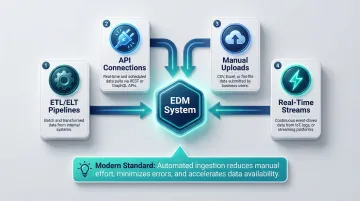
Data enters the EDM system through automated pipelines (ETL/ELT processes), direct API connections, manual uploads, or real-time streams from operational systems like CRMs, ERPs, and IoT platforms. Modern EDM favors automated, event-driven ingestion to reduce lag and human error, though the right approach depends on data source type and business need.
Data Processing and Standardization
After ingestion, raw data is cleaned (removing duplicates, correcting errors, filling gaps), transformed into standardized formats, and enriched with metadata tags that describe its origin, structure, and intended use. This stage is where data quality is first established.
Research published in the Harvard Business Review and MIT Sloan Management Review reveals that 47% of newly-created data records contain at least one critical, work-impacting error. Skipping or under-investing in data processing is a leading cause of unreliable analytics downstream.
Governance and Quality Control
EDM maintains control over data quality and compliance through:
- Role-based access controls
- Data ownership assignments
- Audit trails
- Policy enforcement
- Automated quality monitoring that flags anomalies
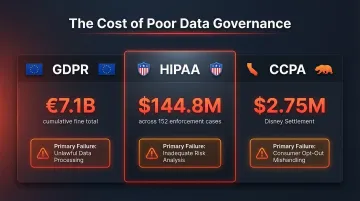
This stage prevents data from degrading silently over time, ensures that sensitive data is only accessible to appropriate roles, and creates the documentation trail required for regulatory compliance (GDPR, HIPAA, CCPA).
| Regulatory Framework | Total Fines | Key Governance Failure |
|---------------------|-------------|------------------------|
| GDPR (EU) | €7.1B cumulative since May 2018 | Unlawful processing and poor retention policies |
| HIPAA (US) | $144.8M across 152 cases | Failure to conduct risk analysis and secure ePHI |
| CCPA (California) | $2.75M Disney settlement (2026) | Failure to honor consumer opt-outs across fragmented data ecosystems |
Access, Analysis, and Output
When collection, processing, and governance are working together, EDM produces clean, consistent, governed data accessible to the right people — through data warehouses, data lakes, or lakehouses — ready for reporting, advanced analytics, or AI model training.
This is where governed data creates direct business value: analysts can query it with confidence, AI tools operate reliably on it, and decision-makers get insights they can act on. Platforms like Sylus are built for this output layer, letting teams connect governed data sources and ask questions in plain English to generate dashboards and analysis without SQL expertise. All analysis is grounded in dbt models and dbt documentation, tying every output to verified, organization-defined metrics.
Key Components of an EDM Framework
A functioning EDM framework is built on several interconnected components—each one handles a distinct aspect of managing data across its lifecycle.
Data Governance
Data governance defines the rules, roles, and responsibilities for how data is managed across the organization—who owns each data domain, who can access it, how it should be used, and what standards it must meet.
Governance isn't just policy documentation. It requires active enforcement through tooling, stewardship roles, and cross-functional accountability.
Platforms like Sylus support governance through SOC 2 Type II and HIPAA compliance, role-based access controls, and integration with dbt models to ensure all analysis operates within validated, documented data structures.
Data Quality Management
Data quality management involves continuous monitoring and remediation of data accuracy, completeness, consistency, and timeliness. Teams should define what "quality" means for each dataset rather than applying a universal threshold.
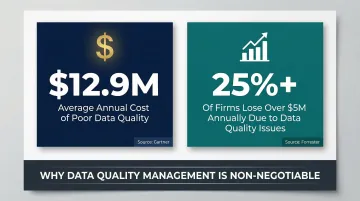
Gartner's research establishes that poor data quality costs organizations an average of $12.9 million per year. Recent 2024 Forrester data shows that more than 25% of data professionals estimate their firms lose over $5 million annually due to poor data quality.
Metadata Management
Metadata management adds the context layer to data—describing its origin, structure, lineage, and relationships—making it easier to discover, understand, and trust. Without metadata, governed data can still be opaque: analysts may not know where a number came from or whether it has been modified.
Data Integration and Lifecycle Management
Data integration connects disparate systems so data flows consistently across the organization. Common mechanisms include:
- ETL/ELT pipelines that extract, transform, and load data between sources
- APIs that enable real-time data exchange between applications
- Middleware that bridges legacy systems with modern platforms
Lifecycle management defines how data is stored, archived, and eventually disposed of based on business need and regulatory obligations — reducing risk and keeping storage environments auditable.
Key Benefits of Enterprise Data Management
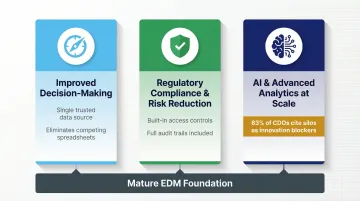
The three most impactful business benefits of mature EDM are:
1. Improved Decision-Making Teams work from a single, trusted version of the truth rather than competing spreadsheets. When everyone operates from the same governed data, decisions become faster and more reliable.
2. Regulatory Compliance and Risk Reduction Access controls, audit trails, and data handling policies are baked in. Organizations avoid costly fines and regulatory exposure by maintaining proper data governance from the start.
3. AI and Advanced Analytics at Scale AI tools require clean, well-structured, governed data to perform reliably. According to the IBM 2025 CDO Study, 83% of CDOs state that data silos and poor integration hinder innovation and impede their organization's ability to conduct real-time analytics.
Operational Efficiency
When data is organized and accessible, analysts spend less time hunting for and cleaning data, and more time generating insights. Two findings put that cost in concrete terms:
- Anaconda's 2023 State of Data Science report found that data preparation and cleaning rank as the top two most time-consuming tasks for data professionals
- Research from Monte Carlo found that data professionals spend 40% of their time evaluating or checking data quality — effectively two full days a week firefighting bad data
With mature EDM, that firefighting time shifts toward actual analysis — because the pipelines, governance policies, and cataloged data assets are already in place before a new initiative launches.
Common EDM Challenges
Data Silos
Different departments use incompatible tools and formats that resist integration. According to Salesforce's 2024 Connectivity Report, 95% of IT leaders report that integration issues impede AI implementation and digital transformation initiatives.
Talent and Skills Gaps
EDM requires a mix of technical expertise (data engineering, governance tooling) and organizational authority that many teams lack. Gartner predicts that by 2030, half of enterprises will face irreversible skill shortages in at least two critical job roles.
The IBM 2025 CDO Study puts a sharper point on it: 47% of CDOs now cite attracting, developing, and retaining talent with advanced data skills as a top challenge — up from 32% in 2023.
Scalability
Systems that work for current data volumes can break or become unmanageable as the organization grows. Disruption can come from multiple directions:
- Adding new data sources or tools to an existing stack
- Updating legacy systems that other pipelines depend on
- Acquiring companies that bring incompatible data environments
Cultural Adoption
Data governance only works if the people who create and use data follow the rules—which requires leadership buy-in, training, and incentives aligned with good data practices. According to Wavestone's 2024 Data and AI Leadership Executive Survey, 77.6% of organizations cite culture, people, process, and organizational alignment as the principal challenge to becoming data-driven, compared to just 23.4% citing technology limitations.

Conclusion
EDM is the infrastructure that turns scattered data into a reliable organizational asset. It works not through a single tool but through a combination of governance policies, quality processes, technical integration, and cultural adoption that must all function together.
Teams that invest in EDM gain more than cleaner pipelines — they build the operational foundation for faster decisions, reliable analytics, and growth that doesn't buckle under data complexity. As volumes increase and regulatory pressure intensifies, the gap between organizations with mature EDM and those without it becomes harder to close.
Frequently Asked Questions
What is the difference between EDM and MDM?
EDM is the overarching framework for governing all organizational data across its lifecycle, while MDM (master data management) is a focused subset that specifically manages core business entities—like customer, product, and supplier records—to ensure consistency and accuracy across systems.
What is the difference between enterprise data and master data?
Enterprise data refers to all data an organization creates, collects, or uses—including transactional records, operational metrics, emails, and logs—while master data refers specifically to the core business entities (customers, products, employees, suppliers) that are shared across multiple systems and processes.
Is EDM part of EPM?
EDM and EPM (enterprise performance management) are distinct disciplines. EDM focuses on governing and managing data assets organization-wide. EPM focuses on measuring and improving business performance through budgeting, forecasting, and reporting. In practice, EPM depends on the data quality and accessibility that EDM provides.
What is an enterprise data management system?
An enterprise data management system is the combination of tools, platforms, and processes an organization uses to implement its EDM strategy. This typically spans data integration platforms, data quality tools, metadata catalogs, governance software, and storage infrastructure such as data warehouses or lakehouses.
What is the enterprise data management framework?
The EDM framework is the structured set of policies, standards, roles, and technologies that define how an organization manages data across its lifecycle. It treats governance, data quality, integration, security, and lifecycle management as interconnected components rather than separate initiatives.
What do you mean by enterprise data?
Enterprise data is any data generated, collected, or used by an organization across its operations. This spans every function and system—from finance and HR to supply chain and customer service—making it the broadest category of organizational data.