AI-powered insights represent a fundamental shift in how organizations extract value from data. Rather than waiting days for an analyst to build a custom report, AI systems automatically detect patterns, surface anomalies, and deliver recommendations in seconds. These insights are conclusions, patterns, and recommendations generated automatically by AI systems—including machine learning, natural language processing, and large language models—after processing large volumes of structured and unstructured data. They go beyond what a human analyst could surface manually in the same timeframe.
This isn't a single product but a capability that can live inside analytics platforms, CRM tools, BI software, or dedicated AI data analysis platforms. This guide covers what AI-powered insights are, how they work, where they add value, and what to look for when choosing a solution.
Key Takeaways
- AI-powered insights use machine learning and statistical models to automatically detect patterns, anomalies, and opportunities in your data
- They offer predictive and prescriptive guidance, not just historical reporting
- Apply across every business function—from sales forecasting to operational efficiency to customer behavior analysis
- The biggest practical advantage: insights that used to take days come back in seconds
- Choosing the right platform means evaluating data governance, model transparency, and fit with your current tools and data sources
How AI-Powered Insights Work: The Technology Behind the Analysis
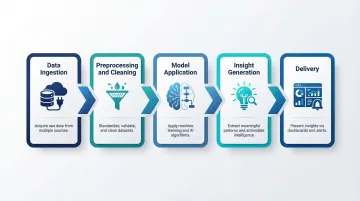
AI-powered insights follow a five-stage pipeline that transforms raw data into decisions you can act on:
1. Data Ingestion - The system connects to structured sources like databases, spreadsheets, and data warehouses, as well as unstructured sources like text documents or logs. Modern platforms support hundreds of integrations to consolidate data from across your tech stack.
2. Preprocessing and Cleaning - Data gets normalized, deduplicated, and formatted so models can consume it properly. This stage handles inconsistencies and prepares data for analysis.
3. Model Application - Machine learning algorithms, statistical models, or large language models run against the prepared data to identify patterns and relationships.
4. Insight Generation - The system surfaces patterns, anomalies, correlations, or predictions based on what the models discover.
5. Delivery - Results appear as natural language summaries, charts, dashboards, or alerts that business users can immediately act on.
Three Core Technology Pillars
Each stage of that pipeline runs on a combination of three technologies working together.
Machine Learning finds patterns without being explicitly programmed for each one. ML models can detect correlations across hundreds of variables simultaneously—relationships no human analyst would think to test for manually.
Natural Language Processing bridges the gap between analysts and business users. Instead of writing SQL, someone can ask "which deals are at risk this quarter" and receive specific, data-backed responses in plain English.
Large Language Models handle the final mile: translating complex analytical findings into readable summaries that non-technical stakeholders can understand and act on without a data team intermediary.
The Critical Role of Context and Grounding
Context determines whether AI output is useful or dangerous. When LLMs query complex enterprise databases without proper grounding, accuracy can be as low as 16.7%. When grounded with a semantic knowledge graph, that jumps to 54.2%—a greater than 3x improvement.
Modern platforms solve this through semantic layers or data catalogs that anchor analysis in your actual data definitions and business metrics. Sylus takes this further by grounding all analysis in dbt models and dbt documentation, so AI agents query consistent, approved business logic rather than raw tables with ambiguous column names.
Descriptive, Predictive, and Prescriptive Insights
AI-powered insights operate at three levels:
- Descriptive — what happened (revenue dropped 12% last week)
- Predictive — what's likely next (churn risk is elevated for this customer segment)
- Prescriptive — what to do about it (offer a discount to the at-risk cohort before they leave)
Validation and Trust Mechanisms
Well-built AI insight tools validate assumptions before presenting results. They explore multiple hypotheses, cross-check against related data, and surface confidence levels or source references rather than presenting a single unvalidated answer as fact. The difference between a tool that validates and one that doesn't is the difference between a data team that trusts AI output and one that spends hours QA-ing it.
AI-Powered Insights vs. Traditional Business Intelligence
Traditional BI tools—static dashboards, pivot tables, pre-built reports—require a human to know what question to ask and how to build the query. They are retrospective and rigid. You build a dashboard showing last month's sales, but if you want to understand why a specific product category underperformed, you need to build a new query or wait for an analyst.
AI-powered insights invert this model. The system proactively surfaces what matters, answers ad-hoc questions in natural language, and flags patterns you didn't know to look for.
The Analyst Bottleneck
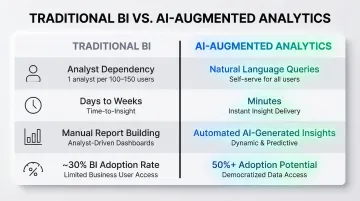
In most organizations, business users depend on a small data team to build and maintain reports. Industry data shows IT and analyst teams often support business users at ratios of 1:100 or even 1:150. This creates a queue where insights take days or weeks to deliver, and many potential insights are never explored because the backlog is too long.
Augmented analytics reduces time-to-insight from days to minutes by allowing users to ask questions in natural language and receive instant, explainable visualizations. This shift democratizes data access — BI adoption rates that have historically hovered around 30% can climb above 50% once business teams can query data without analyst support.
Complementary, Not Mutually Exclusive
AI insights work alongside BI dashboards, not instead of them. You still need dashboards for monitoring core KPIs. AI layers on top of that infrastructure: conversational querying, anomaly detection, automated summaries, and proactive alerts.
| Capability | Traditional BI | AI-Augmented Analytics |
|---|---|---|
| Access | Dashboards, fixed reports | Natural language queries |
| Discovery | Manual hunting | Auto-detected anomalies |
| Analysis | Requires data science tools | Built-in AutoML, forecasting |
| Speed | Days or weeks | Minutes |
Key Benefits of AI-Powered Insights for Data Teams and Business Users
Speed to Insight
Data scientists spend roughly 80% of their time preparing and cleaning data, leaving only 20% for actual analysis. AI-powered insights automate pattern detection, report generation, and anomaly flagging, freeing data teams to focus on strategic work rather than repetitive data wrangling.
For business users, the impact is just as significant. Questions that previously required submitting a ticket and waiting days now get answered in seconds through natural language queries.
Democratization of Data Analysis
AI-powered insights lower the technical barrier to interrogating data. A marketing manager, operations lead, or executive can ask a question in plain English and get a credible answer without writing SQL or waiting for a data analyst.
Given that only 23.9% of organizations report having successfully created a data-driven organization, democratizing access to insights represents a massive opportunity to close the gap between data availability and effective decision-making.
Proactive Anomaly Detection and Alerting
Rather than waiting for a human to notice a KPI has drifted, AI systems monitor data continuously and trigger alerts when significant changes occur. Teams catch problems — and opportunities — before they compound.
Examples include:
- A spike in customer churn
- A drop in conversion rates
- An unusual expense pattern
- Sudden changes in product usage
The difference between catching an anomaly immediately versus discovering it weeks later can mean millions in prevented losses or captured opportunities.
Multi-Variable Pattern Recognition
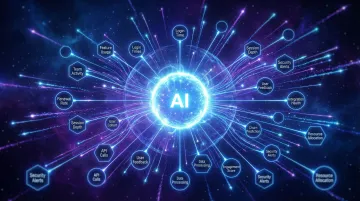
AI models can process hundreds of variables simultaneously and detect non-obvious correlations that no human analyst would test for manually. For example, an AI system might find that users who log in on weekends, activate three specific features together, and invite teammates within the first week renew at a 90% rate — a combination no analyst would think to test manually.
These patterns are nearly impossible to surface through traditional analysis. The number of possible variable combinations grows exponentially, making manual exploration impractical at any meaningful scale.
Results You Can Actually Trust
When insights are grounded in verified data definitions and accompanied by supporting evidence, decision-makers can act with more confidence. AI-powered insights reduce the "I'm not sure if this number is right" problem by surfacing data provenance and validation as part of the output.
Platforms that expose the underlying SQL or show which data models powered a metric let users verify the output themselves — so sign-off happens faster and with fewer second-guesses.
AI-Powered Insights in Action: Use Cases by Business Function
Sales and Revenue Operations
AI-powered insights surface deal health scores, forecast accuracy gaps, pipeline coverage risks, and rep performance patterns. Teams can ask questions like "which deals are at risk this quarter and why" and receive specific, data-backed answers rather than manually compiled reports.
Clari's AI-powered revenue platform delivered 398% ROI and 96% forecast accuracy for enterprise customers, preventing $14 million in wasted spend and saving teams 50% of their administrative time. The platform achieved payback in under six months.
In B2B SaaS, product telemetry is a far better predictor of renewal than CRM sentiment. AI-driven revenue intelligence platforms analyze billions of telemetry data points to predict churn or expansion up to 12 months in advance with 90% accuracy, allowing sales teams to intervene proactively.
Marketing and Customer Analytics
For marketing teams, AI insights go beyond reporting what happened — they surface which audience characteristics actually drove conversion. That means analyzing campaign performance, segment behavior, funnel drop-off points, and content engagement in a single unified view.
Progressive Insurance generated $2 billion in new premiums by training ML models on telematics data to build propensity scoring systems that identify exact moments of high purchase intent. The models achieved roughly 90% accuracy in identifying high-intent leads.
In B2B marketing, AI-driven personalization and account-based targeting yield massive efficiency gains. Ad personalization can slash customer acquisition costs by 50%, boost revenue by 5-15%, and increase marketing efficiency by 10-30%.
Finance and Business Operations
Finance teams use AI insights to catch problems that top-level reports hide. Common applications include:
- Detecting anomalies in expense data before they compound
- Flagging the root cause of budget variances, not just the variance itself
- Modeling cash flow scenarios across multiple business conditions
- Identifying margin erosion tied to supplier cost shifts invisible in summary views
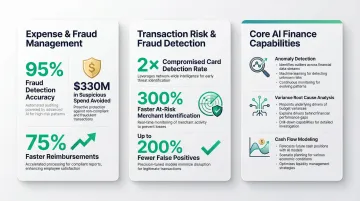
AppZen's AI-powered finance solutions achieve 95% fraud detection accuracy, helping enterprises avoid $330 million in suspicious spending losses and speeding up expense reimbursement by 75%.
The platform uses digital fingerprinting, metadata analysis, and pattern recognition to catch what manual audits miss — including sophisticated AI-generated invoice fraud.
Mastercard's generative AI implementation doubled the detection rate of compromised cards, increased the speed of identifying at-risk merchants by 300%, and reduced false positives by up to 200%.
Product and Engineering Teams
Product and engineering teams apply AI insights to usage telemetry, support tickets, and error logs to answer questions that matter: which features drive retention, where users abandon onboarding, and which technical issues quietly accelerate churn. That intelligence feeds directly into roadmap prioritization.
Amplitude's AI agents continuously monitor product telemetry, autonomously reviewing hundreds of user sessions to spot hidden friction, quantify the revenue impact of UX issues, and recommend specific fixes. Teams no longer have to choose between shipping fast and understanding whether what they shipped actually worked.
Zendesk integrated OpenAI's large language models to analyze customer support interactions at scale, successfully predicting which B2B SaaS clients were at risk of churn and enabling customer success managers to intervene early with tailored offers.
What to Look for in an AI-Powered Insights Platform
Data Connectivity and Integration Depth
The platform must connect to where your data already lives—cloud data warehouses, databases, spreadsheets—and ideally respect your existing semantic layer or data modeling work. Platforms that integrate with dbt models ensure metric definitions are consistent and governed, not re-invented inside the tool.
Look for platforms supporting 500+ integrations across ERPs, finance systems, CRM platforms, databases, and developer tools — the broader the ecosystem, the fewer gaps in your analysis.
Governance, Security, and Compliance
Enterprise buyers should verify that the platform:
- Does not train models on customer data - Neither the platform nor model partners should use your data for training
- Supports role-based access control - Users should only see results they're authorized to view
- Offers self-hosted deployment options - For sensitive environments requiring air-gapped deployment
- Holds relevant certifications - SOC 2 Type II validates security controls, HIPAA compliance ensures Protected Health Information is safeguarded
Platforms like Sylus are built with these requirements as core capabilities—connecting your data sources and allowing questions in plain English while ensuring your data never leaves your governed environment. Sylus maintains SOC 2 Type II compliance and HIPAA certification, with self-hosted deployment available for organizations requiring maximum data isolation.
Ease of Use for Non-Technical Users Alongside Rigor for Data Teams
Look for a platform that lets business users ask questions conversationally while giving data teams the controls to govern what context the AI uses, what data it can access, and how results are validated. That balance means analysts spend less time fielding ad-hoc requests, and business users get answers without waiting on a ticket queue.
The best platforms ground their AI in semantic layers that prevent hallucinations and ensure accuracy. When evaluating options, ask whether the platform exposes generated SQL for transparency, how it validates assumptions mid-analysis, and whether it can handle multi-step analytical workflows end-to-end.
Frequently Asked Questions
What are AI-powered insights?
AI-powered insights are conclusions, patterns, and recommendations automatically generated by AI systems—including machine learning, NLP, and LLMs—after analyzing large volumes of business data, enabling faster and deeper decision-making than manual analysis.
How do AI-powered insights differ from traditional business intelligence?
Traditional BI requires users to know what to ask and build queries manually, while AI-powered insights proactively surface patterns, answer natural language questions, and detect anomalies without requiring technical expertise or waiting for analyst support.
What industries benefit most from AI-powered insights?
While AI insights apply broadly, industries with high data volume and complex decision environments—including retail, finance, healthcare, SaaS, and logistics—tend to see the highest ROI from AI-powered analytics.
How accurate are AI-powered insights?
Accuracy depends on data quality, model grounding, and validation mechanisms. Well-designed platforms validate assumptions and surface data provenance alongside results rather than returning a single unverified answer, with grounded systems consistently achieving accuracy rates above 90% in well-scoped deployments.
What data do you need to get started with AI-powered insights?
Most platforms can begin with structured data from common sources like CRMs, databases, or data warehouses. The key prerequisite is having consistent, reasonably clean data and defined metrics so the AI has accurate, consistent context.