Introduction
Modern data teams face a daunting reality: the average enterprise manages 897 applications, yet only 29% are integrated, creating massive data silos that fragment decision-making. This integration deficit isn't just an operational headache—it's a financial one. Poor data quality and unreliable pipelines cost the average organization $12.9 million annually, with 25% of large enterprises losing revenue due to flawed analytics built on disconnected data.
Data integration platforms address this directly. They extract data from scattered sources—cloud warehouses, SaaS tools, databases, APIs—transform it, and deliver it somewhere centralized and ready for analysis. As organizations adopt platforms like Snowflake (now serving 11,159 customers, including 745 Forbes Global 2000 companies), organizations are racing to build reliable, automated pipelines that keep up with that scale.
This guide covers:
- The top data integration platforms and what makes each one stand out
- Key integration approaches to understand before evaluating tools
- How to choose the right platform for your team's needs
Key Takeaways
- Data integration platforms connect disparate sources and centralize data into warehouses or lakes for reliable, unified analysis
- Top platforms reviewed: Fivetran, Airbyte, Informatica, Talend, and MuleSoft, each suited to different team sizes and technical needs
- Key selection criteria: connector coverage, sync reliability, transformation depth, pricing model, and compliance certifications
- Identify your integration type (ETL, ELT, iPaaS, Reverse ETL) before shortlisting platforms; picking the wrong category is an expensive mistake
- Integration is step one — once your data is unified, a tool like Sylus lets your team query it and generate dashboards in plain English
What Is a Data Integration Platform?
A data integration platform is software that extracts data from source systems, transforms it as needed, and loads it into a target destination—making it accessible, consistent, and ready for analysis. This is distinct from general application integration; data integration focuses on moving and structuring data for downstream use in analytics, reporting, and machine learning.
That downstream use puts data integration squarely between your raw source systems and the analytics layer. In practice, it connects data from sources like:
- CRMs, ERPs, and relational databases
- SaaS applications (Salesforce, HubSpot, Stripe)
- Cloud data warehouses like Snowflake, BigQuery, and Redshift
- Event streams and third-party APIs
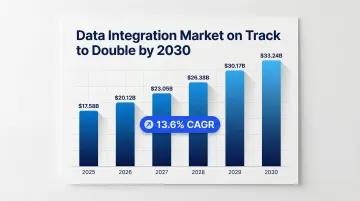
As cloud warehouses gain adoption, demand for reliable, automated pipelines has grown sharply. The data integration software market is projected to expand from $17.58 billion in 2025 to $33.24 billion by 2030—a 13.6% CAGR.
Choosing the right platform depends on your team's use case, technical maturity, and data volume. The platforms reviewed below represent the most widely adopted options available. Once your data is centralized and clean, the next challenge is making it queryable—tools like Sylus let data teams explore that integrated data in plain English, without writing SQL.
Top Data Integration Platforms: Reviewed and Compared
These platforms were evaluated based on connector depth, reliability, transformation capability, pricing transparency, and suitability across team sizes. The five below represent distinct tiers — from zero-maintenance managed pipelines to enterprise-grade governance suites — so the right fit depends heavily on your team's technical depth and scale.
Fivetran
Fivetran is a fully managed ELT platform designed to automate data pipeline maintenance, eliminating the engineering overhead of building and maintaining connectors. Data and analytics teams widely use it on major cloud warehouses — Snowflake, BigQuery, Redshift, and Databricks.
Differentiators: Fivetran's key advantage is its zero-maintenance promise: connectors automatically adapt to schema changes and API updates without manual intervention. It offers 700+ pre-built connectors, a 99.9% uptime SLA, and deep warehouse integrations. Analytics teams that want pipelines to "just work" — freeing engineers for modeling instead of maintenance — will find it a strong fit.
| Aspect | Details |
|---|---|
| Key Features | Automated schema migration, 700+ connectors, incremental data sync, transformation support via dbt integration, built-in observability dashboard |
| Best For | Analytics and BI teams on cloud data warehouses (Snowflake, BigQuery, Redshift) that want low-maintenance, production-grade pipelines |
| Pricing Model | Usage-based pricing tied to Monthly Active Rows (MAR); tiered plans include Free, Standard, Enterprise, and Business Critical |
Airbyte
Airbyte is an open-source data integration platform that has rapidly grown into one of the most popular choices among data engineering teams. It offers both a self-hosted open-source version and a managed cloud offering (Airbyte Cloud).
Differentiators: Airbyte's open-source model gives teams full control over connectors, customization, and deployment. Key advantages include:
- 600+ connectors with a Connector Development Kit for custom builds
- Self-hosted option avoids vendor lock-in and keeps infrastructure costs in-house
- Active open-source community accelerates connector development
- Strong fit for teams with engineering resources who prioritize extensibility
| Aspect | Details |
|---|---|
| Key Features | 600+ connectors, open-source (self-hosted) and managed cloud options, Connector Development Kit, dbt transformations, incremental and full-refresh sync modes |
| Best For | Data engineering teams that want flexibility, custom connectors, or self-hosted deployment for cost or compliance reasons |
| Pricing Model | Open-source version is free (infrastructure costs only); Airbyte Cloud uses a credit-based capacity model with Data Workers |
Informatica Intelligent Data Management Cloud (IDMC)
Informatica is one of the most established names in enterprise data management. Its IDMC platform combines data integration, data quality, data governance, and master data management into a unified cloud-native platform, making it one of the broadest platforms available for large organizations.
Differentiators: Informatica's CLAIRE AI engine powers intelligent data discovery, quality scoring, and pipeline recommendations — layering automation on top of traditional ETL. For enterprises with complex compliance requirements (HIPAA, GDPR) and large volumes of heterogeneous data, its depth in governance and lineage tracking is hard to match in regulated industries.
| Aspect | Details |
|---|---|
| Key Features | AI-powered data integration (CLAIRE engine), data quality and governance, master data management, 400+ pre-built connectors, cloud and hybrid deployment |
| Best For | Large enterprises with strict data governance, compliance requirements, and complex hybrid or multi-cloud environments |
| Pricing Model | Subscription-based using Informatica Processing Units (IPUs); pricing is customized based on data volume, connectors, and modules |
Talend (now part of Qlik)
Talend is a long-standing data integration platform that has been part of the Qlik ecosystem since its acquisition in May 2023. It provides a broad suite of tools covering ETL, ELT, data quality, and application integration, with both open-source (Talend Open Studio) and enterprise editions available.
Differentiators: Talend builds data integration and data quality checks in the same environment, removing the need for separate tooling. Its open-source edition lowers the barrier to entry for smaller teams, while the enterprise platform handles large-scale deployments with advanced governance. The Qlik acquisition has tightened the path from integration directly into BI and analytics.
| Aspect | Details |
|---|---|
| Key Features | Combined ETL and data quality tooling, Talend Open Studio (free tier), 1,000+ components and connectors, cloud and on-premises support, Qlik integration |
| Best For | Organizations that want to handle data integration and data quality in a single platform, or teams already using Qlik for analytics |
| Pricing Model | Talend Open Studio is free; Talend Data Fabric (enterprise) is subscription-based with custom pricing |
MuleSoft Anypoint Platform
MuleSoft, a Salesforce company since 2018, is an enterprise-grade integration platform that covers both application integration (iPaaS) and data integration through its Anypoint Platform. Large enterprises managing complex, multi-system environments widely deploy it.
Differentiators: MuleSoft's API-led connectivity approach structures integrations into reusable API layers, making it easier to scale and govern large integration estates. It excels where Salesforce CRM is central, and Anypoint Exchange offers an extensive pre-built connector library. For organizations needing both application and data integration in one governed platform, MuleSoft is a strong option — though its complexity and cost put it squarely in the enterprise tier, requiring dedicated integration teams.
| Aspect | Details |
|---|---|
| Key Features | API-led connectivity, Anypoint Exchange (pre-built connectors), DataWeave transformation language, hybrid deployment, Salesforce-native integration |
| Best For | Large enterprises managing complex multi-system environments, especially those heavily invested in the Salesforce ecosystem |
| Pricing Model | Subscription-based; pricing is tiered and can be substantial — contact MuleSoft for enterprise quotes |
Types of Data Integration Platforms
Not all data integration tools are built the same way. Matching the right type of platform to your use case is the first decision to make. Here are the four main categories:
| Type | What It Does | Best For | Example Tools |
|---|---|---|---|
| ETL (Extract, Transform, Load) | Transforms data before loading into the destination | High transformation complexity; destinations with limited processing power | Informatica, Talend |
| ELT (Extract, Load, Transform) | Loads raw data into the warehouse first, transforms in-place using SQL or dbt | Cloud data warehouses; analytics-first pipelines | Fivetran, Airbyte |
| iPaaS (Integration Platform as a Service) | Connects applications and automates workflows in real time | Real-time application sync rather than batch pipelines | MuleSoft |
| Reverse ETL | Moves data from the warehouse back into operational tools | Operationalizing warehouse data into CRMs or marketing platforms | Census, Hightouch |
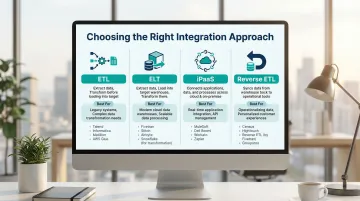
Some platforms like MuleSoft and Informatica span multiple categories, offering both data and application integration capabilities.
Change Data Capture (CDC)
Change Data Capture (CDC) detects and captures incremental changes at the database level by reading transaction logs. This enables pipelines that update in under a second without impacting source system performance.
CDC is critical for operational use cases such as:
- Fraud detection requiring instant data signals
- Real-time customer 360 views
- Low-latency inventory or pricing updates
Most ELT-first platforms like Fivetran and Airbyte support log-based CDC natively; traditional ETL tools often do not. Verify this before committing to a platform if data freshness is a priority.
How We Chose the Best Data Integration Platforms
Each platform was evaluated across six dimensions:
- Connector Coverage & Reliability — Does the platform actively maintain connectors for your specific source systems, including incremental sync (not just full refresh)?
- Transformation Capabilities — Does it support in-flight transformation (ETL) or integrate with tools like dbt for ELT workflows?
- Sync Modes — Does it cover full refresh, incremental sync, and log-based CDC for real-time pipelines?
- Security & Compliance — What certifications does it hold (SOC 2 Type II, HIPAA, GDPR)? This matters if any PII or sensitive business data passes through.
- Pricing Transparency — Is pricing publicly documented? Vendors are shifting to consumption-based models (MAR, credits, IPUs)—audit your data volumes carefully before costs hit the meter.
- Observability & Monitoring — Does the platform provide tools for monitoring pipeline health, detecting schema drift, and alerting on failures?
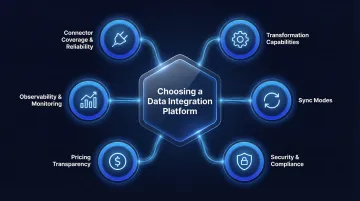
These criteria exist precisely because a common buyer mistake is shortlisting tools on name recognition alone, without verifying whether the connector for their specific source system is actively maintained or supports the sync mode they need. Total cost of ownership—including implementation and ongoing maintenance—should be weighted just as heavily as feature lists.
Tools that are highly niche, lack active maintenance, or are opaque in pricing were deprioritized in favor of platforms with transparent documentation, active user communities, and verifiable enterprise adoption.
Conclusion
The right data integration platform depends on your team's technical maturity, data volume, compliance requirements, and whether your primary use case is analytics pipelines, real-time application sync, or both. There is no single best tool—Fivetran and Airbyte lead for analytics-focused ELT, Informatica and Talend suit enterprise data governance needs, and MuleSoft is the go-to for complex API and application integration at scale.
Evaluate platforms based on total cost of ownership, connector quality for your specific sources, and the vendor's track record on reliability and schema change handling—not just feature lists or analyst rankings.
Getting data into your warehouse is half the work. Once it's unified, your team still needs a fast, reliable way to explore and act on it. Sylus connects directly to your integrated data sources, letting data teams and business users query in plain English, generate dashboards, and get AI-powered analysis — all grounded in your dbt models for consistent, governed results. If you're evaluating your analytics layer alongside your integration stack, explore what Sylus offers.
Frequently Asked Questions
What is cross-platform digital integration?
Cross-platform digital integration is the process of connecting software systems that run on different architectures, protocols, or platforms so they can exchange data automatically. This covers both application-level sync and data pipeline integration across different technology systems.
What are common examples of cross-platform integration?
Common examples include syncing a CRM like Salesforce with a data warehouse like Snowflake via Fivetran, connecting Jira with ServiceNow for cross-team ticket sync, or moving e-commerce order data from Shopify into a central analytics database for reporting and business intelligence.
What are the benefits of cross-platform integration?
Key benefits include:
- Eliminates manual data entry and duplicate records
- Delivers real-time or near-real-time data availability across systems
- Improves decision-making through unified data
- Reduces operational costs by replacing manual data movement with automated pipelines
What is the difference between ETL and ELT in data integration?
ETL transforms data before loading it into the destination, which is better for complex pre-load transformations. ELT loads raw data into a cloud warehouse first and transforms it there using SQL or tools like dbt, which is faster and more flexible for analytical queries at scale.
How do I choose the right data integration platform for my business?
Start by mapping your source systems and target destination. Then evaluate platforms on:
- Connector coverage for your specific sources
- Sync reliability and supported sync modes
- Pricing relative to your data volume
- Compliance support (SOC 2, HIPAA, GDPR)
Verify that connectors are actively maintained before committing.
What is an iPaaS platform and how does it differ from traditional ETL tools?
iPaaS (Integration Platform as a Service) is designed for real-time application-to-application sync and workflow automation. Traditional ETL tools, by contrast, focus on batch movement of data into a storage destination for analytics. iPaaS platforms like MuleSoft excel at connecting live operational systems; ETL/ELT tools like Fivetran are optimized for feeding data warehouses.