Introduction
The average enterprise now manages over 100 SaaS applications—a reality that has turned API integration from a technical detail into an operational bottleneck. Engineering teams can no longer afford to build and maintain dozens of custom 1:1 connectors when each integration takes three weeks or more to ship and requires ongoing maintenance every time a vendor updates their API.
In 2026, the application integration market is projected to reach $38-55 billion as organizations shift from building integrations manually to adopting unified API platforms. Three forces are driving this transition:
- AI-native products now require real-time data access that custom connectors can't reliably deliver
- Stricter data security regulations scrutinize exactly where customer data is stored and processed
- Simple math: custom connectors don't scale when your product roadmap demands 50+ integrations
This guide evaluates the top unified API platforms across five dimensions: architectural approach (pass-through vs. sync-and-store), security and compliance posture, AI-readiness including Model Context Protocol (MCP) support, integration breadth, and developer experience. The right choice depends on your team's priorities—speed to market, data freshness, compliance scope, or AI agent support. Getting that decision right determines how much engineering time goes toward integration maintenance versus building your actual product.
Key Takeaways
- Unified API platforms replace dozens of custom SaaS connectors with a single standardized interface
- Architecture type—pass-through (real-time, zero-storage) vs. sync-and-store (cached, polling-based)—determines your compliance scope and how fresh your data stays
- Top platforms: Merge, Knit, Unified.to, Nango, and Apideck—each suited to different compliance, scale, or developer experience requirements
- Evaluate platforms on architecture type, data storage policy, AI/MCP readiness, integration coverage, and developer experience
What Is a Unified API (and Why It Matters for SaaS in 2026)
A unified API is an abstraction layer that normalizes multiple APIs from the same category—CRM, HRIS, ATS, accounting—into one standardized interface. Instead of building separate connectors for Salesforce, HubSpot, and Pipedrive, developers integrate once and gain access to all three through a common data model.
The business case is compelling. The numbers tell the story:
- The application integration market is projected to grow from $15.4 billion in 2023 to $38–55 billion by 2028–2030 — a roughly 20% CAGR
- 71% of organizations need at least 3 weeks to build a single custom integration
- Enterprises now manage 100+ apps on average, making 1:1 connectors mathematically unsustainable

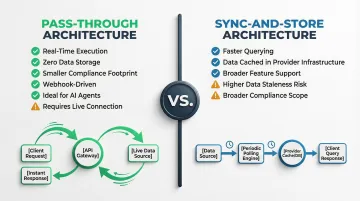
Scale alone doesn't solve the problem, though — architecture does. Platforms differ fundamentally in how they handle data: pass-through architectures execute every request in real-time against the source system with zero data storage, while sync-and-store platforms periodically poll APIs and cache customer data in their own infrastructure.
That distinction has direct implications for data freshness, compliance scope, and long-term maintenance burden. It's also the primary lens we use to evaluate the top five platforms below.
Best Unified API Platforms for SaaS Integration in 2026
These platforms were evaluated on reliability, architectural approach, security posture, integration breadth, AI-readiness, and real-world suitability for SaaS engineering teams building production integrations in 2026.
Merge
Merge is one of the most widely adopted unified API platforms, offering broad coverage across HRIS, CRM, ATS, and accounting categories. It uses a sync-and-store architecture where data is periodically refreshed and cached in Merge's infrastructure, enabling fast querying without hitting rate limits on upstream APIs.
Why it stands out: Merge delivers the fastest time-to-launch across multiple integration categories, with dashboard observability that lets non-technical support teams troubleshoot authentication issues without engineering involvement. The tradeoff: data freshness depends on sync frequency (Merge recommends polling every 24 hours), and customer data is replicated into Merge's infrastructure, raising compliance considerations for security-sensitive teams.
| Aspect | Details |
|---|---|
| Key Features | 220+ integrations across HRIS, CRM, ATS, Accounting, Ticketing; dashboard observability; managed syncs; standardized common data models |
| Architecture / Data Model | Sync-and-store; data periodically polled and cached in Merge's infrastructure |
| Best For | Teams needing to launch integrations across many categories quickly with minimal engineering overhead |
Knit
Knit is built for teams that cannot compromise on security and real-time performance. It uses a zero-storage architecture where data only flows through the system and is never stored at rest, combined with a fully webhook-driven event model.
The case for Knit: Knit's pass-through model eliminates the compliance risk of replicated customer data. It also offers a specialized SDK for AI agent integrations, including function-calling support across enterprise systems like Workday and ADP, making it a strong fit for AI-native SaaS products in 2026. The platform provides remote MCP servers that allow AI agents to execute permissioned actions without storing sensitive data.
| Aspect | Details |
|---|---|
| Key Features | Zero-storage pass-through; 100% webhook-driven architecture; AI agent SDK; MCP support |
| Architecture / Data Model | Pass-through; data never cached or stored at rest |
| Best For | Security-conscious enterprises and teams building AI-native or agent-driven SaaS products |
Unified.to
Unified.to is a real-time unified API platform covering 415+ integrations across 24 categories including CRM, HRIS, ATS, accounting, messaging, file storage, and generative AI. It's designed for SaaS and AI products that need live data access without replicating it into a data warehouse.
Where it excels: Every API call is executed directly against the upstream source at runtime with no background sync jobs. Unified.to exposes integrations as callable tools via a Model Context Protocol (MCP) server, enabling AI agents to interact with SaaS systems safely. The platform is SOC 2 Type II, GDPR, HIPAA, and CCPA compliant, a meaningful advantage for enterprise buyers navigating 2026's regulatory landscape.
| Aspect | Details |
|---|---|
| Key Features | 415+ integrations; real-time pass-through execution; native and virtual webhooks; MCP server for AI agents; deeply normalized schemas |
| Architecture / Data Model | Pass-through; zero data storage, requests processed in memory |
| Best For | SaaS teams and AI product builders needing live data across a wide integration catalog with compliance coverage |
Nango
Nango is a code-first integration infrastructure platform that gives engineering teams full control over sync logic, schema mapping, and polling behavior. It supports 700+ APIs and is built for developers who want to treat integrations as part of their core codebase.
The developer angle: Nango allows developers to write custom TypeScript sync logic and schema transformations, making it flexible for non-standard integration requirements. It also supports self-hosting, which appeals to enterprises with strict data residency needs. The tradeoff: teams must own and maintain all sync pipelines and mappings themselves, increasing engineering overhead compared to managed platforms.
| Aspect | Details |
|---|---|
| Key Features | 700+ supported APIs; TypeScript integration runtime; OAuth infrastructure; proxy API; self-host option |
| Architecture / Data Model | Code-first sync; polling-based with local cache, custom developer-defined schemas |
| Best For | Engineering teams that want full control over integration logic and prefer a code-first, self-managed approach |
Apideck
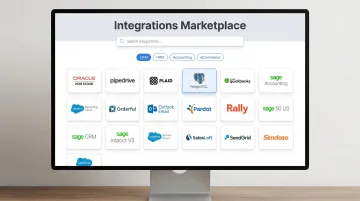
Apideck offers a real-time pass-through unified API across CRM, HRIS, accounting, ecommerce, and issue-tracking categories. It also offers a "Marketplace-as-a-Service" capability that lets SaaS companies launch a white-labeled integration marketplace on their website in minutes.
The GTM advantage: In addition to its pass-through architecture (no customer data stored), Apideck's marketplace product serves both a technical and go-to-market function: product and marketing teams can use integrations as a customer acquisition tool. It includes virtual webhooks and standardized rate-limit headers to simplify retry logic across providers, reducing the engineering burden of handling provider-specific quirks.
| Aspect | Details |
|---|---|
| Key Features | Real-time pass-through; virtual webhooks; Proxy API; white-labeled integration marketplace; multi-category unified APIs |
| Architecture / Data Model | Pass-through; no customer data stored, responses returned directly from upstream API |
| Best For | SaaS teams that want both technical integration infrastructure and a public-facing integration marketplace for lead generation |
How We Chose the Best Unified API Platforms
The most common mistake teams make is choosing a platform based solely on integration count or brand recognition, without evaluating the architectural model—which directly affects data freshness, compliance scope, and long-term maintenance burden.
Evaluation Criteria
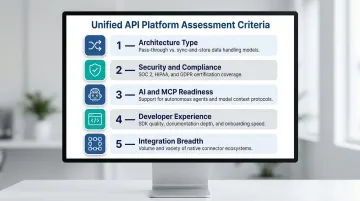
We assessed platforms across five dimensions:
1. Architecture type and data model — Pass-through platforms execute requests in real-time with zero storage; sync-and-store platforms cache customer data. The tradeoff: pass-through shrinks your compliance footprint and keeps data fresh, while sync-and-store simplifies querying but adds latency and audit scope.
2. Security and compliance certifications — SOC 2 Type II, HIPAA, GDPR, and CCPA compliance matter because HHS guidance explicitly states that cloud providers storing encrypted ePHI are business associates, even without decryption keys. Pass-through architectures materially shrink audit scope.
3. AI and MCP readiness — Anthropic's Model Context Protocol (MCP) has over 10,000 active public servers deployed. Platforms with native MCP servers allow AI agents to call integrations as structured tools without storing sensitive customer data—critical for AI-native products.
4. Developer experience and customization depth — If integrations are commodity infrastructure, a managed platform's speed to market wins. If they're core product IP, code-first flexibility justifies the maintenance overhead.
5. Integration breadth and category coverage — Integration count is a poor proxy for coverage. What matters is whether the platform supports the specific tools your customers use and exposes the endpoints your product actually needs.
Tying Criteria to Business Outcomes
These criteria don't carry equal weight for every team. A sync-and-store platform gets you to first integration faster—but that speed comes with ongoing compliance overhead and stale data risk.
For products handling sensitive customer data or building toward AI agents, the compliance footprint and real-time access requirements will likely tip the decision toward pass-through. Your product architecture and roadmap should drive the call, not integration count alone.
Conclusion
Choosing a unified API platform in 2026 is a strategic infrastructure decision. The platform you pick will shape your security posture, your ability to support AI-native features, and how much engineering capacity goes toward integration maintenance rather than your core product.
Don't evaluate based on integration count alone. Before committing, pressure-test each platform on the factors that actually affect your build:
- Data freshness fit: Does the architecture match your latency and sync requirements?
- Compliance coverage: Do its certifications align with your customer base and regulatory obligations?
- AI/MCP readiness: Does it have a clear story for where your product roadmap is heading?
The architectural choice between pass-through and sync-and-store has downstream effects on compliance scope, data staleness, and long-term maintenance burden — trade-offs worth mapping before you're locked in.
Once your integrations are live and data is flowing in from CRM, HRIS, accounting, and other SaaS tools, the next challenge is making sense of that data at speed. Sylus gives data teams and business users an AI-powered analytics layer to query and visualize connected data in plain English, without waiting on a SQL analyst—turning your integration infrastructure into actionable insights.
Frequently Asked Questions
What is the difference between a unified API and a regular API integration?
A regular API integration is a custom 1:1 connector built for a single provider. A unified API is an abstraction layer that normalizes multiple providers in the same category into one standardized interface—so developers write integration code once and gain access to many tools.
What is the difference between a pass-through and a sync-and-store unified API?
Pass-through APIs execute every request directly against the source system in real time with no data stored. Sync-and-store platforms periodically poll and cache customer data in their own infrastructure. The most significant tradeoff is compliance risk, followed by data freshness and how much ongoing maintenance each approach requires.
Which unified API platform is best for building AI agents and LLM-powered products?
Platforms with MCP (Model Context Protocol) server support and pass-through architecture—such as Knit and Unified.to—are best suited for AI-native products. They allow AI agents to call integrations as structured tools without storing sensitive customer data.
How much does a unified API platform typically cost?
Pricing models vary significantly across platforms:
- Merge: per linked account, starting at $650/month for up to 10 accounts
- Unified.to: usage-based, starting at $750/month for 750k API calls with unlimited connections
- Nango: tiered from $50/month based on connections and compute time
- Apideck: per active consumer, starting at $599/month for 25 consumers
Forecast costs based on both connection volume and API call frequency — these two variables drive most bills.
Can unified API platforms be self-hosted?
Some platforms like Nango offer self-hosting options for teams with strict data residency or compliance requirements. Most managed platforms (Merge, Unified.to, Apideck) operate as cloud-hosted services. Self-hosting adds infrastructure management overhead but gives full control over where data is processed.
How long does it typically take to implement a unified API in a SaaS product?
With a managed platform, initial setup takes hours to days rather than weeks per connector. Full production deployment—covering auth flows, webhook handling, and error management—typically lands within one to two sprints, with some teams shipping to production in two to three weeks.