Introduction
Businesses today are drowning in data but starving for foresight. Organizations collect terabytes of customer behavior, transaction records, and operational metrics—yet struggle to answer the most critical question: what happens next? This disconnect between historical data and future insight costs the global retail industry alone $1.73 trillion annually in inventory distortion. Predictive AI exists precisely to close that gap—converting historical records into probability-weighted forecasts about what comes next.
This guide covers:
- What predictive AI is and how it works
- How it differs from generative AI
- The three analytics tiers and real-world use cases
- Key benefits and risks enterprises must navigate
TLDR:
- Predictive AI analyzes historical data patterns to forecast future events with quantified probability
- It differs fundamentally from generative AI—predictive forecasts outcomes, generative creates content
- Analytics tiers: descriptive (what happened), predictive (what will happen), prescriptive (what to do)
- Applications include fraud detection, demand forecasting, patient readmission risk, and credit scoring
- Major risks include encoded bias from flawed training data and automation over-reliance
What Is Predictive AI?
Predictive AI is the use of statistical analysis and machine learning algorithms to identify patterns in historical data and forecast likely future outcomes, behaviors, or events. Unlike broad artificial intelligence, predictive AI has a specific mission: turning what has already happened into probabilistic forecasts about what will happen next.
The Technology Stack: Predictive AI, Analytics, and Machine Learning
These terms are often used interchangeably, but they serve distinct roles:
- Predictive AI is the technology layer—the algorithms and infrastructure that power forecasting
- Predictive analytics is the practice—how organizations apply these tools to business problems
- Machine learning is the core methodology—the statistical techniques that enable computers to learn patterns without explicit programming
The Role of Big Data
More high-quality historical data generally produces more accurate predictions. The global predictive analytics market reflects this growth trajectory, projected to grow from $10.2 billion in 2023 to $63.3 billion by 2032—a 22.4% compound annual growth rate.
However, data quality matters more than volume alone. Research on data valuation frameworks demonstrates that low-quality or mislabeled data actively corrupts model performance, proving that targeted data cleaning improves accuracy more effectively than simply adding more records.
Historical Context
That emphasis on data quality isn't new—it's the lesson statisticians learned long before machine learning existed. Actuaries, economists, and operations researchers have used regression models to forecast trends for decades. What shifted was scale: modern innovations like XGBoost and distributed computing frameworks now allow data scientists to process billions of examples and thousands of variables simultaneously, far surpassing what legacy linear models could handle.
What Predictive AI Is NOT
Predictive AI does not guarantee future outcomes. It produces probabilistic forecasts with varying confidence levels, not certainties. A model predicting 80% probability of customer churn means 8 in 10 similar customers will leave—but which specific customers will churn remains uncertain.
How Does Predictive AI Work?
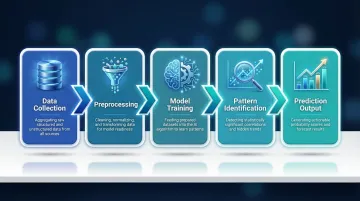
Predictive AI operates through a structured machine learning pipeline that transforms raw data into actionable forecasts.
The Core Pipeline
- Data collection: Organizations gather historical records from CRM systems, transaction databases, sensors, or operational logs
- Preprocessing: Data scientists clean missing values, remove outliers, and format data for analysis
- Model training: Algorithms scan historical datasets to detect patterns — no hard-coded rules required
- Pattern identification: The model identifies statistical relationships between input variables and outcomes
- Prediction output: The trained model scores new data, assigning probabilities to future events
Concrete Example: Customer Churn Prediction
A subscription business trains a model on two years of customer data, including usage frequency, support tickets, payment delays, and contract length. The algorithm identifies that customers who reduce usage by 40% and miss two payments have an 85% probability of canceling within 60 days. When a new customer exhibits this pattern, the model flags them for retention outreach.
Embeddings and Vector Representations
Predictive AI converts data points into mathematical vectors to measure similarity. Two customers with similar purchase histories and engagement patterns land close together in that vector space — which is how a model can scan millions of records and surface relevant matches in milliseconds.
Main Algorithm Types
Regression models forecast numerical outcomes—revenue next quarter, expected customer lifetime value, or equipment failure time remaining.
Classification models predict categorical outcomes—will this transaction be fraudulent (yes/no), which customer segment does this prospect belong to, or will a patient be readmitted within 30 days.
Time series models capture temporal patterns—seasonal demand fluctuations, weekly website traffic trends, or hourly energy consumption forecasts.
The Feedback Loop and Model Drift
Predictive models improve over time as new data feeds back into training. Real-world behavior doesn't stay static, though — consumer preferences shift, economic conditions change, and unexpected events (a supply shock, a market downturn) can invalidate assumptions baked into older models. This is called model drift.
Organizations manage drift by monitoring incoming data continuously and setting retraining triggers — typically weekly, monthly, or dynamically when accuracy metrics fall below a defined threshold.
Three Types of Predictive Analytics
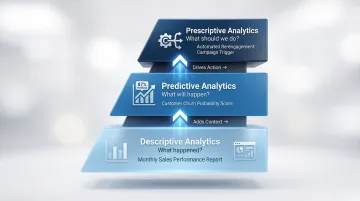
Most data strategies follow a three-tier framework — descriptive, predictive, and prescriptive — each building on the one before it. Gartner, Forrester, and McKinsey all use this structure to map how organizations progress from reporting to forecasting to automated decision-making.
Descriptive Analytics: Understanding the Past
What happened?
Descriptive analytics uses business intelligence tools and dashboards to summarize historical data and visualize past performance. Organizations use this tier to report quarterly sales figures, track current inventory levels, or review last month's website traffic.
It's the starting point for everything that follows — without a clear picture of the past, forecasting the future has no grounding.
Predictive Analytics: Forecasting the Future
What is likely to happen?
Predictive analytics uses machine learning, regression, and statistical modeling to forecast probabilities and future trends. This tier enables organizations to forecast product demand, predict equipment failure, score credit risk, or anticipate patient readmissions.
It connects historical insight to forward-looking action — taking what descriptive analytics surfaces and turning it into probability-based guidance for decision-makers.
Prescriptive Analytics: Recommending Action
What should we do next?
Prescriptive analytics uses optimization algorithms and simulation to recommend specific actions that optimize for a desired outcome. This tier moves beyond insight into decision support — dynamically adjusting prices, routing supply chain logistics, or automating inventory replenishment.
The accuracy of prescriptive recommendations depends directly on the quality of the predictive models underneath them. Weak forecasts produce unreliable recommendations; strong ones make automation genuinely useful.
Predictive AI vs. Generative AI
Predictive AI and generative AI are built on different architectures, trained on different data, and solve different problems. Confusing them leads to the wrong tool for the job.
Core Functional Distinction
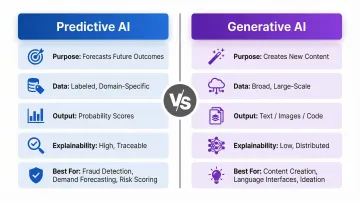
Predictive AI forecasts future events based on existing data patterns—will this customer churn, what will demand be next quarter, is this transaction fraudulent.
Generative AI creates new content (text, images, code) based on learned patterns—drafting marketing copy, generating product images, or writing software functions.
Predictive AI extrapolates real-world probabilities from historical data. Generative AI calculates the statistical likelihood of the next word in a sequence through "next-token prediction" — a language task, not a forecasting one.
Common misconception: ChatGPT is generative AI. While it uses statistical prediction to generate the next token, that's language modeling — not forecasting real-world business outcomes. Don't use generative AI for tasks requiring precise numerical forecasting.
Data Requirements
Predictive AI requires high-quality, labeled, domain-specific datasets. A fraud detection model needs millions of labeled transactions marked as fraudulent or legitimate. A patient readmission model requires clinical records with confirmed readmission outcomes.
Generative AI is trained on broad, diverse datasets where scale matters more than precision labeling. Large language models consume billions of web pages, books, and articles — prioritizing volume over domain specificity.
Explainability and Transparency
Predictive AI outputs are traceable to the statistical inputs that produced them, making them more interpretable. Traditional machine learning models allow for feature importance tracking—you can identify that payment history contributed 40% to a credit decision while income contributed 25%.
Generative AI outputs, produced through deep neural networks, are difficult to audit — the reasoning behind any specific output is distributed across billions of parameters with no traceable path back to a single cause.
When to Use Each
The right choice depends on what your output needs to accomplish:
Use predictive AI when you need:
- Data-driven forecasts (demand planning, risk scoring)
- Probabilistic outcome predictions
- Explainable, auditable decisions
- Structured data analysis
Use generative AI when you need:
- Content creation, summarization, or ideation
- Natural language interfaces
- Creative exploration
- Unstructured data synthesis
For high-stakes financial or operational forecasting, traditional predictive machine learning remains the superior, more explainable choice.
Predictive AI Use Cases Across Industries
Healthcare: Clinical Predictions and HIPAA Compliance
Predictive AI transforms patient care by forecasting adverse events before they occur. Advanced models predicting 30-day hospital readmissions achieve Area Under the Curve (AUC) scores of 0.78 to 0.93, significantly outperforming baseline methods. In oncology, an AI system for breast cancer screening achieved an 11.5% higher AUC than the average human radiologist, reducing false positives by 5.7% and false negatives by 9.4%.
Compliance requirements: Deploying predictive AI on Protected Health Information requires strict HIPAA adherence. The HHS Office for Civil Rights mandates that PHI used for AI training must be properly de-identified using either "Safe Harbor" or "Expert Determination" methods. AI systems processing electronic PHI must also satisfy the HIPAA Security Rule, which requires:
- Rigorous access controls and user authentication
- Complete audit logs for all PHI interactions
- Encryption of data at rest and in transit
Finance and Insurance: Fraud Detection and Credit Scoring
Financial institutions rely heavily on predictive AI to mitigate risk. In fraud detection, AI models process millions of transactions in milliseconds to identify anomalies. Visa reported saving $40 billion in fraudulent transactions globally in 2023 using AI systems. HSBC used machine learning to monitor 900 million monthly transactions, resulting in a 60% reduction in false positives and cutting detection time from weeks to just eight days.
The speed advantage over human analysis is decisive—algorithms flag suspicious patterns in real-time, preventing fraud before it completes rather than detecting it after losses occur.
Retail and Supply Chain: Demand Forecasting and Inventory Optimization
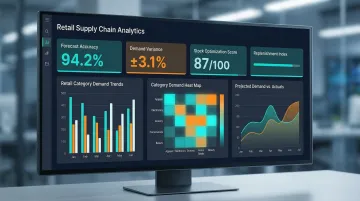
Poor demand forecasting costs retailers $1.73 trillion annually in inventory distortion—the combined cost of stockouts (lost sales) and overstocks (wasted inventory). Predictive AI directly attacks this margin leakage.
According to McKinsey, applying AI-driven forecasting to supply chains can reduce forecasting errors by 20% to 50%, translating to a 65% reduction in lost sales and a 5% to 10% decrease in warehousing costs. Dynamic pricing models adjust prices in real-time based on predicted demand, competitor pricing, and inventory levels, optimizing revenue while clearing excess stock.
Business Data Analytics: Making Predictive Insights Accessible
Modern AI-powered analytics platforms allow data teams and business users to surface predictive insights directly from their own datasets by asking questions in plain English. Rather than requiring SQL expertise or data science degrees, these platforms put forecasting capabilities directly in the hands of the people who need them.
Tools like Sylus act as an AI data analyst that explores your connected data, validates assumptions, and surfaces predictions while alerting teams to spikes in key metrics. Business users can ask "What will demand look like next quarter?" and receive instant forecasts grounded in their dbt models and governed data context — no specialized training required.
A 2024 Gartner survey found that 58% of finance functions are currently using AI, up 21 percentage points from the previous year. Yet adoption alone doesn't guarantee results: 60% of enterprise leaders report a data skills gap within their organizations. The bottleneck is not a shortage of AI tools — it's foundational data literacy.
Benefits and Risks of Predictive AI
Benefits
Speed and Scale
Predictive AI processes millions of data points and returns forecasts in seconds, well beyond human analytical capacity. Idaho Forest Group reduced financial forecasting time from 80 hours a month to under 15 hours—a 25% time savings across the entire finance department. Packaging manufacturer Novolex reduced its supply chain forecasting process from six weeks to less than one week (an 83% reduction) while simultaneously reducing excess inventory by 16%.
Proactive Decision-Making
Organizations shift from reactive to proactive strategies—anticipating demand surges, churn risk, or equipment failure before they happen. Siemens Healthineers integrated predictive analytics into clinical diagnostic systems to monitor components proactively, resulting in a 36% reduction in system downtime compared to reactive maintenance.
Risks and Limitations
Two failure modes appear most often in production deployments:
- Biased training data that encodes historical inequities into model outputs
- Automation bias that leads teams to over-rely on predictions without scrutiny
Bias in Training Data
If historical data reflects past biases—racial, socioeconomic, or otherwise—the model will perpetuate and potentially amplify those biases in its predictions under the guise of objective mathematics.
Real-world example: In 2014, Amazon built an AI recruiting tool to score resumes. Because the model was trained on 10 years of historical resumes from a male-dominated tech industry, the system taught itself that male candidates were preferable, actively penalizing resumes containing the word "women's" and downgrading graduates of all-women's colleges. Amazon scrapped the project in 2018.
The same dynamic plays out when biased proxies stand in for direct measurements. A 2019 Science study analyzed a healthcare algorithm used to manage populations for millions of patients. The algorithm used "historical healthcare costs" as a proxy for "health needs." Because unequal access to care means less money is historically spent on Black patients compared to White patients with the same level of sickness, the algorithm systematically deprioritized sicker Black patients for high-risk care management programs.
Inherent Uncertainty
Predictions are probabilistic, not deterministic. Over-reliance on model outputs without human oversight introduces real risk, especially in high-stakes domains like healthcare or criminal justice.
Psychologists call this "automation bias": the tendency to over-rely on automated outputs while reducing active scrutiny of contradictory signals.
Enterprises should design "human-in-the-loop" workflows where predictive AI serves as an advisory tool. That means requiring active validation rather than passive acceptance of model outputs.
Frequently Asked Questions
What is predictive artificial intelligence?
Predictive AI uses machine learning and statistical analysis to analyze historical data patterns and generate probabilistic forecasts about future events or behaviors. It transforms what has already happened into actionable predictions about what will happen next.
What is the difference between generative AI and predictive AI?
Predictive AI forecasts future outcomes from existing data patterns—will this customer churn, what will revenue be next quarter. Generative AI creates new content like text, images, or code. They use different models, data requirements, and serve fundamentally different purposes.
Is ChatGPT predictive AI or generative AI?
ChatGPT is generative AI. While it uses statistical prediction to generate the next word in a sequence, it is not designed to forecast real-world future events the way predictive AI does. It predicts language patterns, not business outcomes.
What are the three different types of predictive analytics?
The three tiers are descriptive (what happened—historical reporting), predictive (what will likely happen—probabilistic forecasts), and prescriptive (what action should be taken—decision optimization).
Can AI do predictive analytics?
Yes. Modern AI—specifically machine learning models—is the primary engine behind predictive analytics, enabling faster and more accurate pattern recognition than traditional statistical methods.
Which AI is best for predictive analytics?
The best choice depends on the use case. For structured business data, regression and classification models are proven workhorses. For time-series forecasting, specialized temporal models excel. Many modern analytics platforms now expose these capabilities through natural language interfaces, so data scientists aren't the only ones who can use them.